
The short answer
A verge undercloak is a narrow strip, such as fibre-cement or plastic, fixed along the gable edge of the roof beneath the last row of tiles. It supports those edge tiles, carries the mortar on a bedded verge and closes the gap to the wall. When it breaks or sags, the verge above loses its seat.
What the undercloak is for
At a gable, the roof ends beside a wall and the tiles stop short of it. The last row of tiles, the verge tiles, overhang the wall slightly. Beneath that overhang sits the undercloak, a narrow strip running up the slope that gives the verge tiles a firm seat and bridges the space between the wall head and the underside of the tiles. Without it, the edge would have a hollow under it that mortar alone could not fill reliably.
On a mortar verge, the undercloak also carries the mortar. The bedding is laid on top of the strip and the verge tiles sit in it, so the strip is what the mortar and the tiles depend on. Where a trim or cleat takes over the fixing, as on a dry verge, the roof still needs something to support the edge.
- It gives the edge tiles a level seat along the gable.
- It carries the mortar bed on a bedded verge.
- It shuts the opening between the tiles and the top of the wall.
- It keeps wind from getting under the edge tiles.
The roof verge answer describes the verge as a whole, and the undercloak is the part under it that is hardest to see from the ground, since the verge tiles hide most of it.
What it is made of and how it fails
Undercloak strips have been made in several materials. Fibre-cement and plastic are two. Because a roof can carry a strip put in at any time since it was built, the material on a given gable can differ from its neighbour's. Each material has its own ways of ageing, so a strip that looks intact from below can still be cracked along its upper face.
| Material | What can go wrong |
|---|---|
| Fibre-cement | Cracking, breaking up at the edge |
| Plastic | Warping, splitting, sagging |
| Any material | Missing sections, loose fixings |
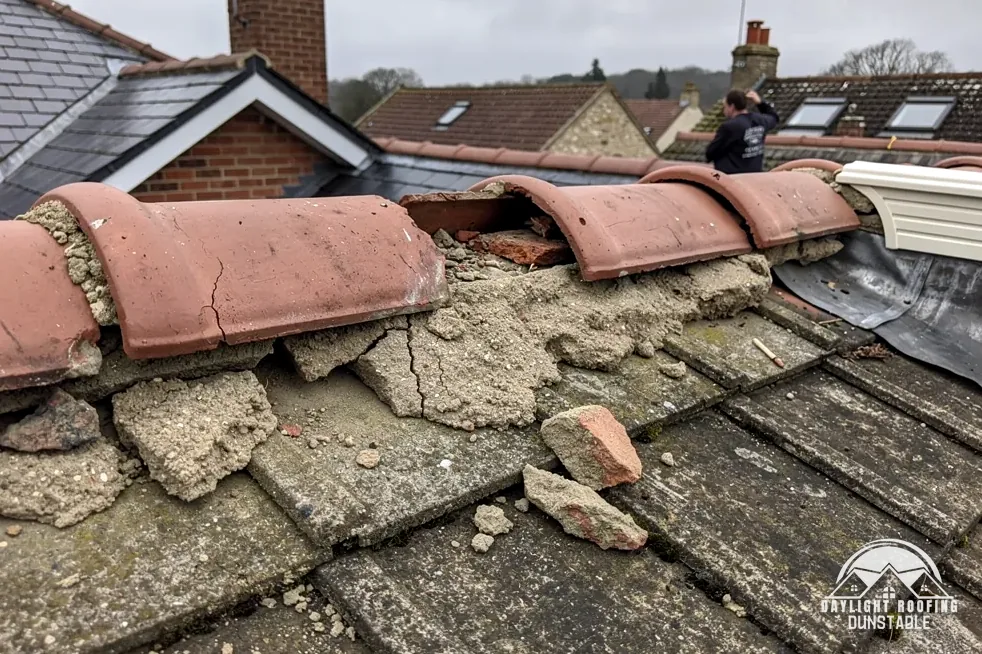
A failing undercloak can show from the ground. Look along the gable for a verge that dips between the tiles, a gap showing under the edge tiles, mortar falling away in lumps, or a tile at the verge that has dropped. Any of these can mean the strip underneath has cracked or moved, and the mortar above it is no longer supported.
Fresh mortar on top of a broken strip leaves the strip broken, and the new bed can follow the old one within a short time. The mortar verge repairs guide covers how a verge is rebuilt, including the strip beneath it.
Older fibre-cement and asbestos
A fibre-cement undercloak on an older roof raises a question that is worth asking before anyone cuts, drills or breaks it. HSE says: "If the building was built or refurbished before 2000, assume that there is asbestos in it." That sentence is a reason to read HSE's guidance first, and it is not a finding about any particular strip.
HSE separates asbestos work into licensed, notifiable non-licensed and non-licensed, and sets out which materials fall where. Its pages are the place to check, and its guidance is where the rules on handling and disposal are set out. A reader who suspects asbestos should not break the strip up or scrape it, and should read HSE's guidance before any work starts.
HSE's guidance, and not a roofer's opinion, is the reference on asbestos. If a strip on a gable might contain it, leave the strip whole and follow HSE's guidance, since asbestos work is specialist work to arrange separately. A photograph of the verge sent on WhatsApp to 07880 284133 can still show the state of the edge.
For the dry route, the dry verge systems guide covers the fittings that can replace mortar. The ridge and verge repairs hub gathers the rest of the set in one place.