
The short answer
Every common covering can be cleaned, but not with the same method. Tile, slate and flat roofs each need an approach suited to the material, and a fragile roof, or one that may be asbestos cement, is first a safety question. HSE says to assume asbestos in buildings built or refurbished before 2000.
Tiles, slate and flat roofs side by side
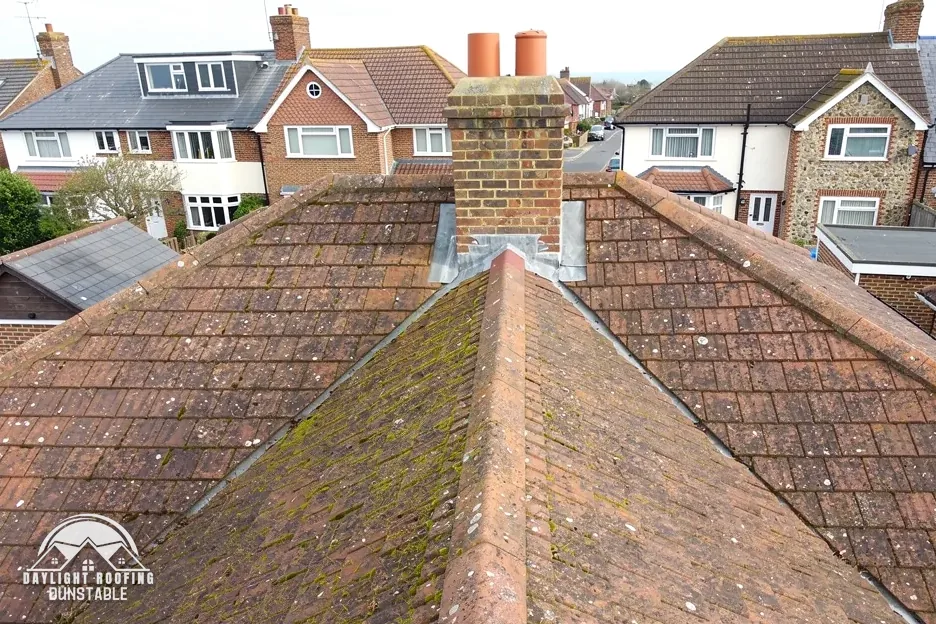
Moss, lichen and algae can grow on coverings of every type, so asking whether a roof can be cleaned is really asking what the surface underneath can stand. A concrete tile, a clay tile, a slate and a membrane are all built differently, and a method that suits one can harm another.
Strong washing shows the difference clearly. Marley, a tile maker, says that "the use of high powered jet washes is not recommended as it can damage the surface of the slate or tile, thus reducing its expected life considerably". That comes from the manufacturing side, and it is why the method is chosen after looking at the roof and not before. The guide to roof cleaning methods compared sets the main ways of cleaning a roof next to each other.
| Covering | What to weigh first |
|---|---|
| Concrete tiles | Surface wear, method chosen for the tile |
| Clay tiles | Surface and edges, method chosen for the tile |
| Natural slate | Brittle edges, how the slates are held |
| Flat roof membrane | Surface damage, standing water, access |
| Fragile sheeting | Whether it can be walked on at all |
Concrete and clay tiles are looked at in the guide to cleaning concrete and clay roof tiles, and slate has a page of its own on how to clean a slate roof.
Flat roofs and conservatory roofs
A flat roof is a membrane or a sheet covering, not a lapped one, and a different set of risks applies. The surface can be scored by a hard brush or a scraper, and a seam or an upstand can be lifted by one careless pass. Algae and moss on a flat roof can collect where water stands, so a survey looks at the fall and whether water is ponding. The guide to cleaning a flat roof goes through what the covering and its edges can take.
Conservatory roofs are a further case. Polycarbonate and glass are smooth, and the framing, seals and glazing bars around them are the weak points, so a method suited to a tiled roof is not carried across. HomeBuilding gives polycarbonate a typical lifespan of 10 years, which is a reason to check the condition of the sheet before any cleaning that could scuff it.
Natural slate raises the matter of brittle edges and nail fixings, and old or reclaimed slates can be thin. A slate that is already cracked can break under a boot or a brush, so cleaning can lead to a repair as well. Where tiles have slipped or a ridge has moved, the clean and the repair can be planned together.
Fragile roofs and asbestos cement
Some roofs should not be walked on until their condition is known. HSE's guidance reads: "If the building was built or refurbished before 2000, assume that there is asbestos in it." Its A14 guidance adds that "AC roofs are always fragile", meaning asbestos cement sheeting. Garages, outbuildings and older extensions can carry sheet roofing, so the age of the building is the first thing to pin down.
HSE puts different jobs into different categories. Roof sheeting made of asbestos cement, handled or taken off carefully without breaking up, falls under non-licensed work. Sheeting that has been substantially damaged is notifiable non-licensed work. Most work on asbestos insulating board is licensed, and HSE lists "AIB white soffit panels to underside of roof eaves" among the places that board is found.
A roof that might be asbestos cement is not something to scrub, scrape or wash on a hunch. Read HSE's guidance first and establish what the covering is. If you are unsure what you have, keep off it and treat it as asbestos cement until an asbestos surveyor has said otherwise. The roof cleaning hub gathers the other guides in one place.