
The short answer
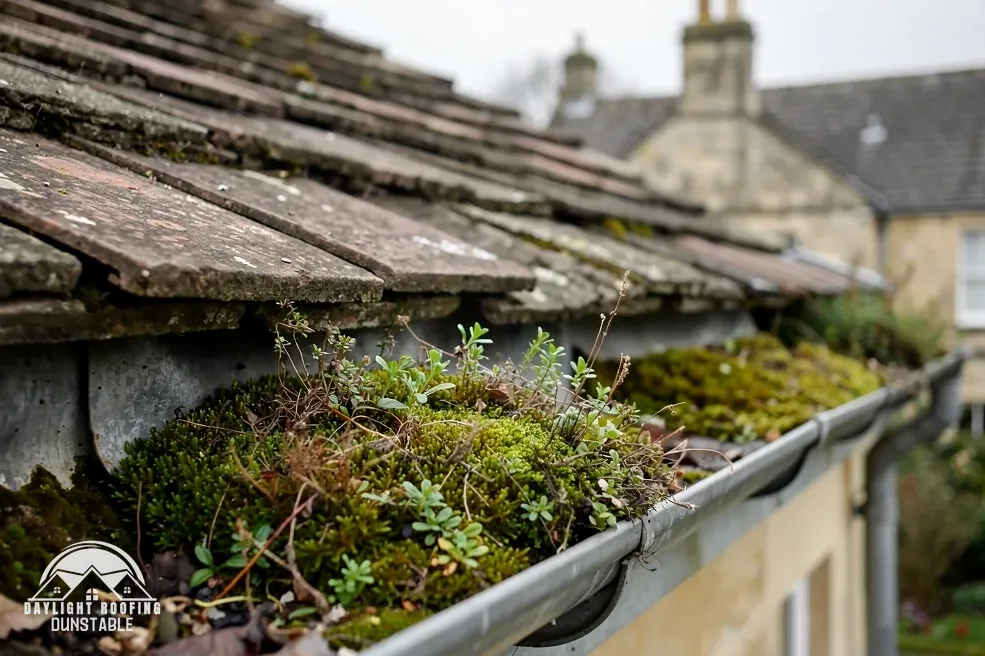
Yes. Moss loosened from tiles washes or drops into the gutter, where it can clump over an outlet and narrow the downpipe. Rainwater then spills over the gutter edge and can leave damp marks on the wall below, so a clogged outlet is the first thing to check.
How moss ends up in the gutter
Roof moss grows in the laps and across the surface of tiles, and it does not stay put. Wind, rain and frost loosen it, and rainwater carries the pieces down the slope. The gutter sits at the bottom of every slope, so it is where the debris lands. A roof that is covered in moss therefore feeds a steady supply of material into the run below it.
Moss on its own is soft and spongy, and it mixes with grit from the tiles, leaves and seeds blown onto the roof. Together they form a mat that settles in the gutter bed. Where the mat reaches an outlet, it can cover the opening like a plug. The water banked up behind it must escape somewhere, and the lip of the gutter is the lowest point left.
Every gutter run slopes slightly towards its outlet. Brett Martin gives 1 mm for every 600 mm, which is a gentle slope, so debris does not wash through by itself. A run that sags, or one that was never quite level, collects water and debris in the low spots and holds them there. The page on why a gutter overflows in heavy rain goes through the other causes.
Signs the moss is blocking the run
The clearest sign is a curtain of water coming over the lip of the gutter during rain, either along its length or at one spot above the outlet. Look too for water pouring down the wall from a joint or a corner, and for green growth or silt in the bed of the gutter. A downpipe that stays dry in heavy rain while the gutter above it is full suggests that the outlet is plugged.
| Sign | What it points to |
|---|---|
| Water over the front edge | Run full or outlet plugged |
| Stains or damp on the wall below | Overflow soaking the masonry |
| Dry downpipe in heavy rain | Blockage above the outlet |
| Green growth in the gutter bed | Moss and silt settling |
Damp is the knock-on effect worth watching. Water that spills over a gutter runs down the wall instead of down the pipe, and it can leave green stains on brickwork, damp patches inside the house, and wet around the foundations. Overflow at the eaves can also reach the fascia and soffit timbers. Those parts are looked at on the page about clearing gutters after a roof clean.
What to check and what to do first
Start from the ground in dry weather. Look along the gutter for sagging, moss in the bed and joints that have opened, and look at the downpipe for a blockage at its top. In rain, watch where the water goes from a safe spot indoors or under cover. If it spills at one place, the outlet there is the likeliest cause. A torch and binoculars from the garden are enough to see a lot.
A low run can be cleared from a stable ladder with a scoop, working into a bucket, but moss that has built up in downpipes or in high gutters needs proper access. Tipping debris on the ground and not rinsing it down the pipe keeps the blockage from moving further along. As a guide to cost, a Which? survey of 11 Trusted Traders in November 2025 gave "£75-£350" for emptying the gutters of a house, excluding VAT.
Clearing the gutter treats the symptom. If moss keeps arriving, the roof above is the source, and the guide to moss, lichen and algae on roofs shows what is growing. The roof cleaning hub covers the clean itself, and gutter cleaning and winter covers the colder months.