
The short answer
Zinc or copper strips are fitted below the ridge in the hope that rain running over them will discourage moss on the tiles beneath. They do not remove growth that is already there, and a wide or shaded slope can leave parts of the roof out of reach. Treat a strip as a possible helper, not a cure.
What a strip is meant to do
The idea behind a zinc or copper strip is simple. A narrow band of metal is fixed along the roof, tucked under a course of tiles near the ridge with an edge left showing. Rain runs over the metal and carries a trace of it down the slope, and the trace is said to make the tile surface a poorer place for moss and algae to settle.
That is how the strips are supposed to work, and no result is fixed for any particular roof. The effect depends on rainfall, on how the water runs down the covering and on what is already growing. Nothing about a strip cleans a roof that has moss on it today. It acts, if at all, on what might grow later.
Copper and zinc are different metals, and the strip is only one part of the picture. The covering matters too, since a rough concrete tile holds moss differently from a smooth clay one. If you are weighing up a strip, ask what the supplier says it does for your type of tile and how far down the slope the claim runs, and compare that with your own roof.
Where a strip falls short
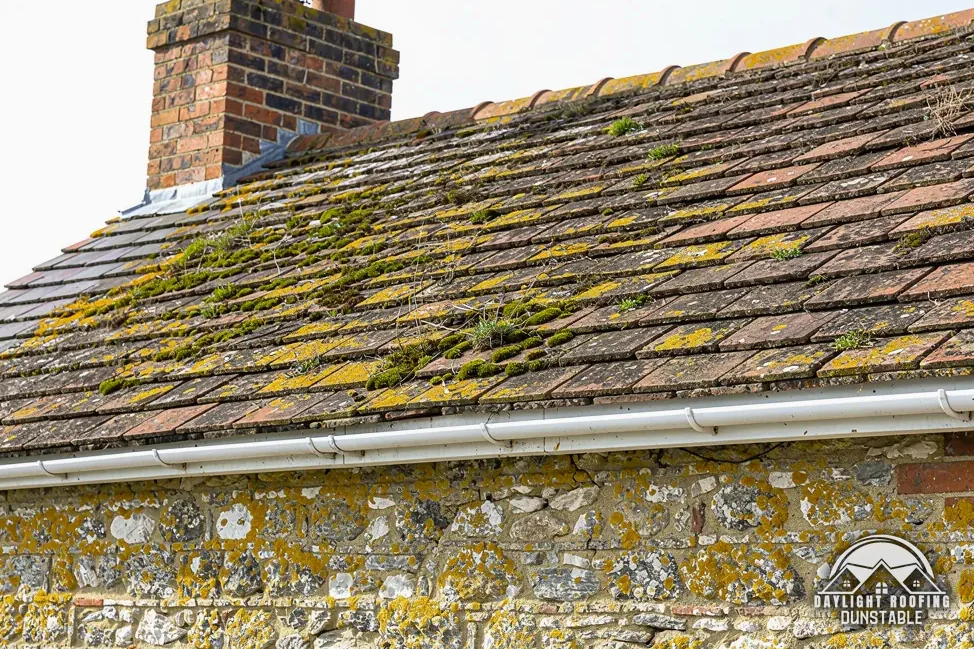
A strip works from the top down, so its reach depends on the length of the slope. On a long run of tiles, the lower courses sit a long way from the metal, and the water has to carry its trace the whole distance. Moss can still take hold at the eaves, in the valleys and around chimneys and dormers, where water does not pass under the strip at all.
Shade is the second weakness. A slope under overhanging trees, or a north-facing slope that stays damp, gives moss good conditions however much metal is above it. A strip also leaves an already mossy roof exactly as it is, so a roof that needs a clean still needs a clean. The table sets out the main limits.
| Situation | Why a strip may not be enough |
|---|---|
| Moss already present | A strip does not remove it |
| Long or wide slope | Lower courses sit far from the metal |
| Shaded or damp slope | Growth conditions stay good |
| Valleys, eaves, chimneys | Water may not run past the strip |
What deals with moss that is already there
Moss that has settled in the laps has to be taken off, and the surface treated afterwards. The routes are hand scraping, a soft wash and a biocide treatment, and each has its own limits, which suit different roofs and different amounts of growth. The guide to what kills moss on a roof sets them out, and the page on biocide roof treatments explains what a treatment can and cannot do.
Regrowth is a fact of life on a shaded roof, whichever approach is used. Keeping gutters clear, trimming back branches that drop leaves and shade the tiles, and checking the roof from the ground each season all help the surface stay drier. A metal strip is also no reason to reach for a jet wash, which Marley does not recommend for tile or slate because of the surface damage it can cause. Moss that regrows quickly is a sign to look again at the shade and the gutters.
A strip is also fitted by lifting tiles, and every lifted tile is a tile that can crack. Before strips are added to a roof, the tiles need looking over so any that are cracked or slipping are known about beforehand. The moss, lichen and algae guide and the roof cleaning hub are the places to continue.