
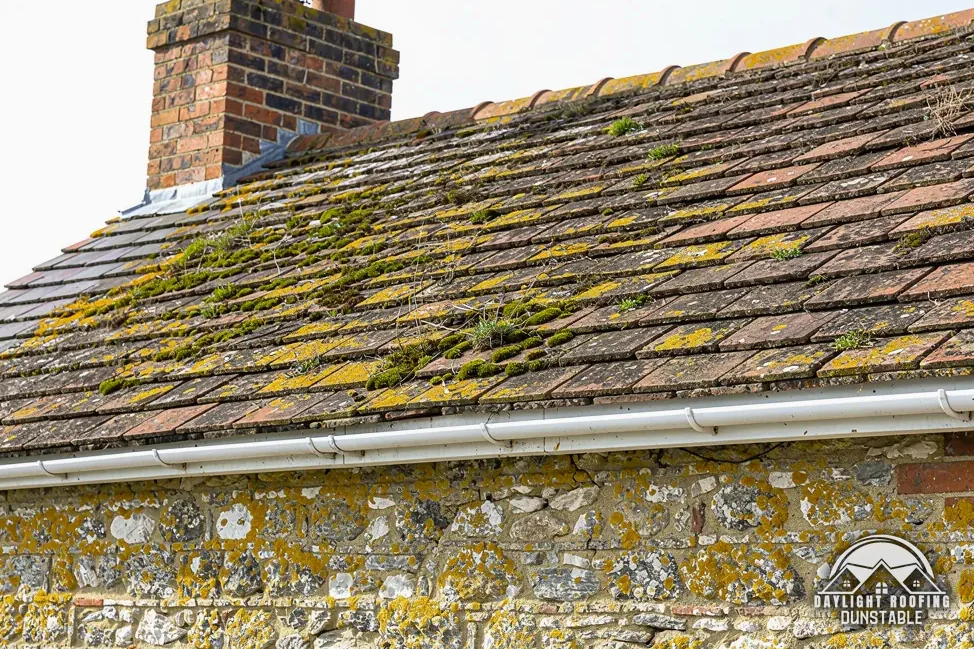
The short answer
Moss on a roof is dealt with in two steps: the growth is taken off by hand with a soft brush or scraper, then a treatment made for roofs is applied to kill what remains. The product label sets how it is used. Marley treats a forceful jet as a poor match for roof tiles, saying it is "not recommended".
Take the growth off first
Moss is a living mat with threads that grip the surface of a tile, so a treatment sprayed over a thick layer has a lot to get through. Step one is clearing the bulk by hand, with a soft brush or a scraper that will not gouge the tile. Work moves from the ridge down towards the lowest course, so loosened material drops onto tiles still to be done and the gutters are left until last.
Removal brings its own risks. A tile has a surface layer, and hard scraping can wear it away, so the pressure applied matters more than the tool chosen. Roofs also differ: rough concrete holds moss more tightly than a smooth glazed tile, and an old, brittle tile may not take even a brush. Judging which approach suits a given roof is a job for the survey.
Dead moss left in place keeps moisture against the tile, so it should not be killed and then simply left hanging there. Taking it off also uncovers the surface, which shows any split or displaced tile that the growth was hiding. The page on moss, lichen and algae on roofs explains the three growths and how they differ from one another.
Then a treatment used to its label
Treatments for roof moss, called biocides here, are products made to kill moss, lichen and algae. One goes on after the bulk of the growth is off, and it is meant to act on what remains in the pores of the tile and on spores that would otherwise start a fresh patch. Coverings differ, so the label is the guide to follow. It names the surfaces the product suits, the strength to use, the method of application, the things to protect and the time to wait before anyone goes back out.
A product used outside its label can mark the roof or harm the plants below the eaves. Find out which product is planned, and get hold of its label before the work begins. Weather plays a part as well, since rain soon after application can carry a treatment off the roof and into the garden. The biocide roof treatments guide goes into how these products work.
A treatment does not clear growth at once. Dead moss can sit on the tiles until rain and wind bring it down, so a treated slope can stay green for a spell. The effect builds as the growth dies and drops away, and no duration can be given in advance because it depends on the roof, the product and the weather over the following weeks.
What does not work well
Some approaches cause more trouble than they cure. The table sets the main ones against what to watch for.
| Approach | What to watch for |
|---|---|
| Hand brushing or scraping | Gentle pressure on the tile |
| Roof treatment to its label | Plants and run-off |
| High powered jet wash | Surface damage to the tile |
| Household cleaner on the roof | Not made for roofs, so check first |
Marley, a tile maker, says "The use of high powered jet washes is not recommended as it can damage the surface of the slate or tile, thus reducing its expected life considerably". A fast jet may look like a shortcut, and it stays a poor choice for that reason. For a gentler route that does not risk damage to the tile, see the post on moss on roof tiles without a jet wash.
Whatever kills the moss, the conditions that grew it are still there afterwards. Shade, damp and slow drainage are all worth looking at. The main roof cleaning page explains how they fit in, and a spell of dry weather helps both the clean and the treatment. Where the growth returns quickly, the slope concerned is worth a closer look.