
The short answer
Moss can harm concrete roof tiles, though not by eating them. It sponges up rain and keeps the tile damp, it can fill the laps and block gutters, and frost on a wet mat can add to the wear. A thin patch is a smaller worry than a thick mat, so how much moss there is and where it sits both count.
How moss wears on a concrete tile
A concrete tile has a rougher, more porous face than a glazed or fired surface, and moss finds grip there. Once settled, moss acts like a sponge. It takes up rain and releases it slowly, so the tile under a mat stays damp for much longer after a shower than the clean tiles around it. Constant damp is the root of what moss does to a roof.
Frost is the next link. Where water sits in a damp mat and the temperature drops, it can freeze in place, and ice expands as it forms. Repeated freezing and thawing at the face of a tile can work at it over the seasons. This is how freeze and thaw acts on damp masonry and concrete in general, not a measured rate for any roof, so it is a reason to watch the roof rather than a countdown.
Moss is not the same as algae or lichen, and each sits differently on the tile. Lichen can bond tightly to the face, and dark algae streaking is mostly a matter of appearance. The guide to moss, lichen and algae on roofs shows how to tell them apart from the ground.
Laps, gutters and where water goes
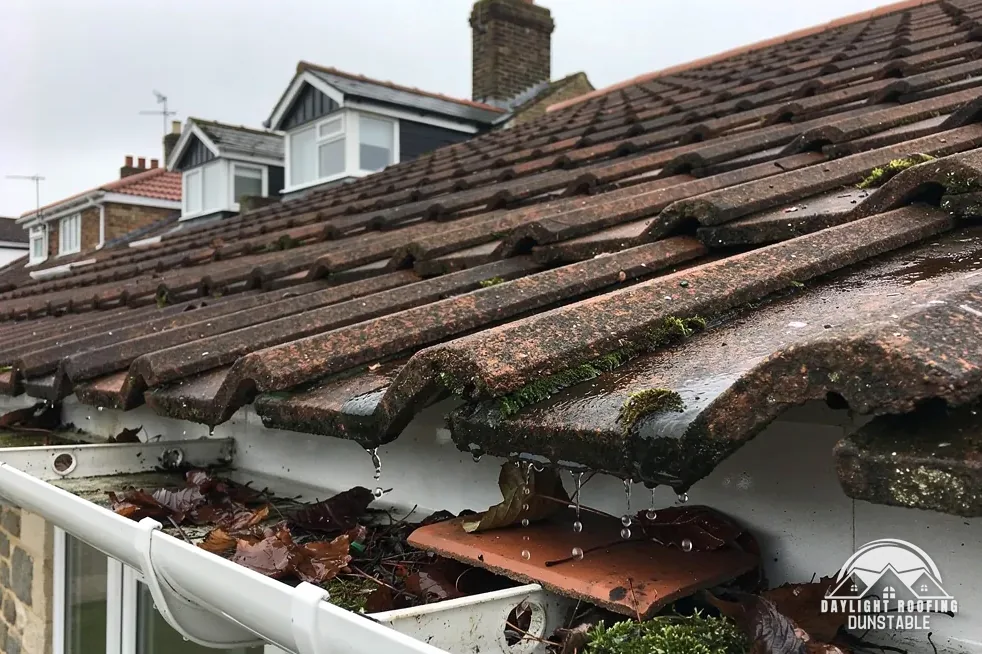
Tiles overlap so that water runs off them, one course onto the next. A thick growth of moss in the laps can hold water against the overlap and can push the courses slightly apart, which gives rain a way in on a driving day. Moss can also grow across the junction where tiles meet the ridge or a valley, and channel water sideways instead of down.
At the bottom of the slope, moss that loosens falls into the gutter. Once an outlet is blocked, the water spills past the gutter's lip, and the fascia and the wall below get wet. A gutter full of wet moss is also heavy, and it can pull on its brackets. Our page on whether moss can cause a roof to leak covers the water-entry side, and this page is about what the moss does to the tile.
| Where | What can happen |
|---|---|
| On the tile face | Keeps it damp; frost can act on the wet mat |
| In the laps | Holds water and can lift courses slightly |
| At ridge and valley | Can send water sideways |
| In the gutter | Can block the outlet and cause overflow |
Lifespan, cleaning and what to check
Sources give different lifespans for concrete tiles, and both are worth setting side by side. Marley says that "Typically, roof tiles are expected to last for around 60 years" and adds "This is not a guarantee or warranty of its longevity." HomeBuilding gives plain concrete tiles "40-50 years" as an approximate lifespan. Neither figure says what moss does to a given roof, so they are not a prediction, and a roof's age alone does not show how much life it has left. Condition, shade, pitch and upkeep all vary from one house to the next.
Removing moss is where a concrete roof can be damaged by the cleaning itself. Marley says that "the use of high powered jet washes is not recommended as it can damage the surface of the slate or tile, thus reducing its expected life considerably". The page on cleaning concrete and clay roof tiles looks at the gentler approaches.
From the ground, look for thick green mats, tiles with a flaking or crumbling face, damp patches in the loft and overflowing gutters. A photo sent on WhatsApp, 07880 284133, will be looked at, and the roof can then be surveyed. The roof cleaning hub gathers the guides in one place.