
The short answer
No fixed interval applies to every house, so a clean is judged from the roof, not the calendar. Shade, overhanging trees, pitch and the type of tile all change how quickly moss and algae return. Check the roof from the ground now and then, look at the gutters, and book a survey when growth is building up.
What decides how soon growth returns
A roof is not cleaned on a timetable because roofs do not grow moss on one. A south-facing slope in open sun dries quickly and may stay clear for a long stretch. A north-facing slope under a tree can hold damp for weeks and gather a green film far sooner. Two houses on the same street, with the same tiles, can therefore need different attention. Even on one roof, the slopes differ: the side facing a row of trees or a taller neighbouring building may carry growth while the side facing the sun is clean. A single date picked in advance would be wrong for one of them.
Shade and trees weigh heavily. Branches drop leaves, seeds and twigs onto the tiles, and they cut off sun and wind that would otherwise dry the surface. Pitch matters because a shallow slope sheds water more slowly than a steep one, and the type of tile changes how readily growth takes hold, since a rough face holds more than a smooth one.
| Factor | Effect on regrowth |
|---|---|
| Shade from trees or buildings | Slower drying, growth settles sooner |
| Overhanging branches | Leaf litter and damp on the tiles |
| Shallow pitch | Water leaves the slope more slowly |
| Rough tile face | More for moss to grip |
How to read your own roof
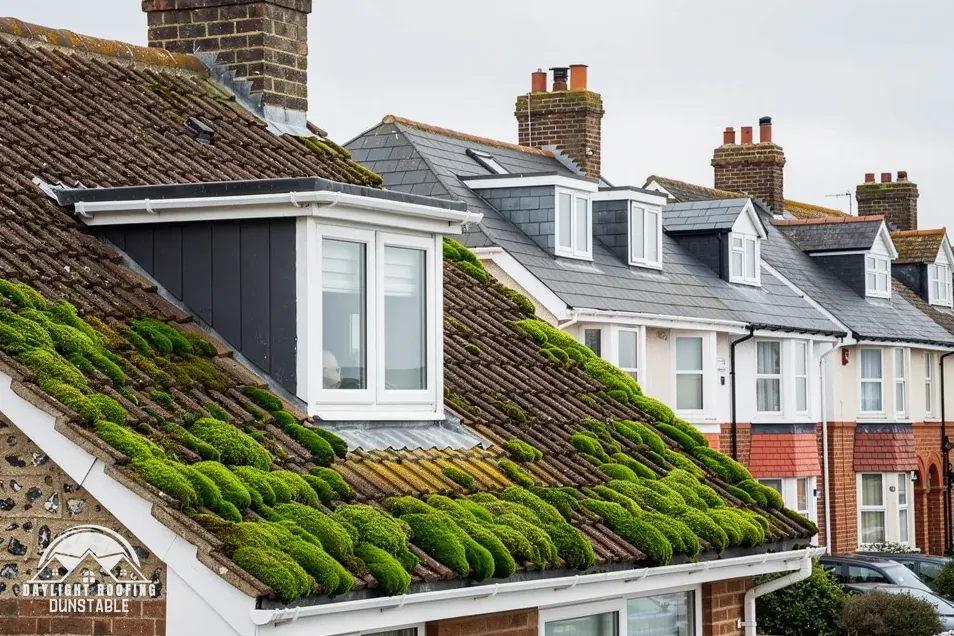
Standing back on the lawn or across the road, binoculars in hand, look for green or grey mats in the laps, a dark band along the lower courses, patches of lichen and moss at the eaves. Check the ridge and the valleys too, because growth gathers where water lingers. Photograph the roof, so that you can compare it with a later look and see whether anything has changed.
The gutters tell their own story. Moss, grit and leaves in the bed of the gutter suggest growth on the roof above, and water spilling over the edge during rain suggests a blockage. A look at the gutters after stormy weather, and after leaf fall where trees are close, catches a problem before it reaches the wall. The page on whether moss comes back after roof cleaning covers regrowth.
A thin film of algae is mainly a matter of looks and can be left under watch, while a thick mat in the laps deserves attention sooner. The guide to biocide roof treatments explains how a treatment after cleaning is meant to slow regrowth, and what it cannot be relied on to do.
When to book a survey
A survey is worth asking for when growth reaches the laps, when gutters keep filling with moss, when tiles look flaky or loose, or when damp shows indoors. None of these proves a clean is the answer, which is the reason for looking before deciding. A roof that is clean and dry needs nothing done to it, however long it has been since the last visit.
Weather affects the timing of the work itself. The page on which time of year suits roof cleaning explains why dry, mild spells suit it and why frost and nesting birds can hold it back.
A photo on WhatsApp, 07880 284133, or a call to 01582 935272, is a way to begin, and any price comes after the survey as one written figure. Moss that has been removed and treated can return in time if the shade and damp that fed it are still there, so the first check after a clean is worth doing when the next wet spell has passed. The roof cleaning hub brings the related guides together, and nothing on it sets a cleaning interval for your house, because the roof in front of you gives a better guide than any rule.