
Call 01582 935272

Bledlow · 22 road miles south-west

Roofers in Bledlow

Roof repairs, leadwork and chimney flashings for Bledlow homes, from a Dunstable roofing firm that surveys first and gives one total in writing.

Get a written quote

Call 01582 935272WhatsApp us

Council
Buckinghamshire
Road miles
22
Conservation area
Bledlow
Building control
Buckinghamshire Council

Bledlow roofs, lead details and a Grade I church

Bledlow is a village in Buckinghamshire, 22.2 road miles south-west of Dunstable, about 41 minutes by road. Its parish is Bledlow-cum-Saunderton, which had 2,634 usual residents at the 2021 Census. Planning applications for Bledlow go to Buckinghamshire Council, which has designated the Bledlow Conservation Area. The Church of the Holy Trinity is listed Grade I and the Manor House Grade II*, so the first question about a roof can be one of status. Lead on a house can hide in valleys, behind parapets and under bay roofs, where the eye from the ground does not reach.

Roofs with valleys, parapets, bays and chimney stacks depend on lead in a way a plain slope does not. We survey the roof before quoting, tell you plainly what we found, any extra fault included, and quote one written total. See lead roofing and leadwork for the work itself and chimney repairs where the stack is the problem.

  1. 01Church of the Holy TrinityGrade I (list entry 1125801), first listed 21 June 1955, and a Church of England church, so roof repairs go through the faculty system.
  2. 02Manor HouseGrade II* (entry 1125803), first listed on 21 June 1955; roof work there is judged against its special architectural and historic interest.
  3. 03Old Vicarage and the CrossThe Old Vicarage (entry 1159893) and the Churchyard Cross (entry 1159905) are both Grade II.
  4. 04Lead flashings and guttersValleys, bay roofs and chimney trays rely on sheet lead, which is made in codes and fixed to allow for movement.
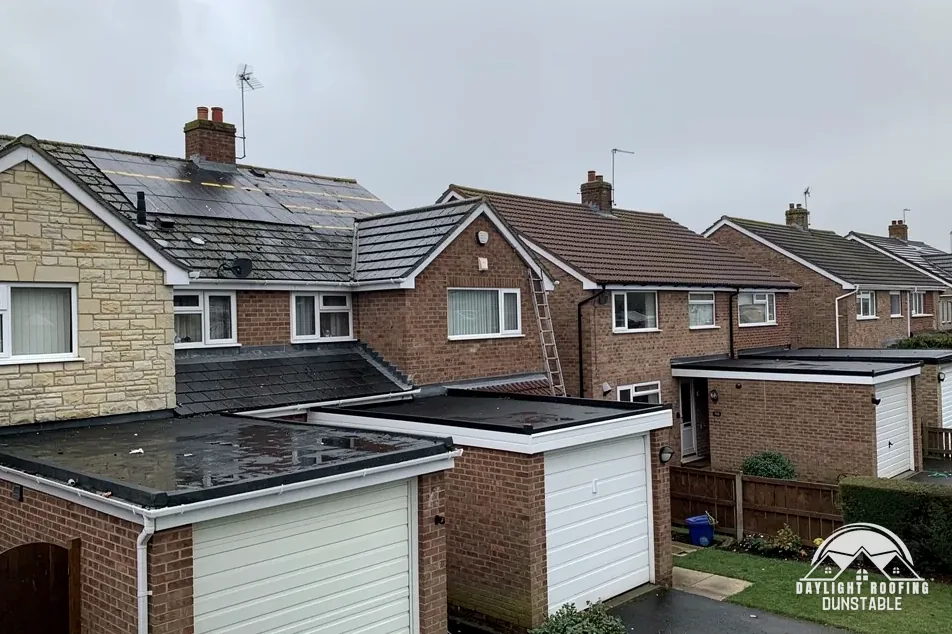
Brick semis with concrete tile roofs and flat-roofed garages

Bledlow words in plain English

Lead code
A number from 3 to 8 that gives the thickness of rolled lead sheet.
Welt
A folded seam that joins two lead sheets and keeps water out.
Chimney tray
A lead layer that carries water out of a chimney stack to the roof.
Parapet gutter
A lined gutter that runs behind a low wall at the edge of a roof.

The plain-as-day roof check

Lead on a Bledlow roof: what to look for

4 checks about 3 minutes to read

  1. Valleys and parapet gutters
  2. Reading a lead code
  3. Splits and cracks in the sheet
  4. Chimney trays and wall flashings

01 Valleys and parapet gutters

A valley between two slopes, or a gutter set behind a parapet, takes the run-off of a whole roof area, which puts a heavy load on its lining. In lead, each sheet laps the next and is dressed up the sides under the tiles. Look for a split along a fold, a sheet that has slipped down, or moss packed into the channel. Valleys are formed in different ways: a lead-lined valley sits in a timber trough, with the tiles stopping short of the centre line to leave the channel open. Where tiles overlap the lead too tightly, debris is trapped and water backs up under the edge.

The survey follows the line of the channel from top to bottom, and then looks at the ceiling directly below it for a stain. If a section is split, the sheet is replaced rather than patched with mastic, because sealant is not a substitute for a joint that has been formed and lapped. A short length of valley is a small job, but the cost depends on the access. If the lead is sound but blocked, clearing the channel by hand and testing the run with a hose can be all the repair needs. A lining that is stretched, cracked or perforated is a different case and is replaced for the length affected.

02 Reading a lead code

Rolled lead sheet is made to BS EN 12588 in codes 3 to 8. Code 4, for example, is 1.80 mm thick, code 5 is 2.24 mm and code 6 is 2.65 mm. Each detail gets its code from the written specification, so a gutter lining, a flashing and a chimney tray need not use the same one. A higher code means a thicker, heavier sheet. Which code suits which detail is set by the specification, and no single number suits every job.

Weights per square metre differ between makers for some codes: Calder gives code 6 as 30.05 kg/m² and Ecobat as 30.10 kg/m². That is why the thickness is the figure to go by, not a general idea of heavy or light lead, and why a replacement is specified from the detail on the roof, not copied from a neighbour's. On a listed or protected building, the choice of lead and the way it is dressed can be part of what the council or the church wants to see, so the detail is agreed with them first.

03 Splits and cracks in the sheet

Sheet lead expands in warm weather and shrinks as it cools. A sheet that is fixed too rigidly, or laid in lengths that are too long, cracks across its width as it tries to move. Look for a thin line across a flat run of lead, a crack at a corner, or a raised ridge where the metal has crept down a slope. Long runs of lead are laid in short lengths with joints, such as welts or rolls, to allow for movement. A joint pinched shut or a roll that has flattened stops the sheet moving, which is where cracks begin.

MyJobQuote says correctly installed lead flashing can last for over 80 years, and for higher codes over 100 years with minimal maintenance. A split in a younger roof can point to how the lead was fixed or to a sheet that was too thin for its length. Knowing the cause is what lets the repair be done properly, rather than just closing the crack. Do not smear sealant along a crack. It masks the problem for a season and then lets go, and the real repair then starts with cleaning the old sealant off the metal.

04 Chimney trays and wall flashings

Where a chimney stack rises through the roof, lead is built in to carry any water that gets into the brickwork back out to the surface. At a wall, a stepped flashing sits in a cut groove and is dressed over the tile edge. The detail is out of sight until it fails, and then a damp mark shows on the chimney breast or beside the wall. A chimney tray is hidden inside the stack, so signs of failure appear indoors first: damp on the breast, peeling paint beside the chimney or a musty smell in the room.

Chimney leadwork is a specific job, with its own third-party figures: MyJobQuote's typical figure for a chimney lead flashing patch repair is around £200, and a full replacement averages around £570. Those figures are for chimney leadwork only. A tray fault is confirmed from the roof, so the survey includes a close look at the stack.

The dashed ring takes in the nearest towns and villages we cover around Bledlow. Map tiles © Esri; map data © OpenStreetMap contributors.

Bledlow lead and roof questions, answered

01How do you find where a lead valley on a Bledlow roof is leaking?

The survey follows the valley from the top to the bottom, looking at the laps, the folds and the dressing up under the tiles on each side, and then checks the ceiling or wall below for a stain that lines up with it. A split can be hard to see against dull, weathered lead, so we look closely along each fold. Any other fault noticed on the way is passed on to you, and a written total price follows. Where a valley has been leaking for a while, the boards under the lead may be damp or rotted, and the survey says whether they are sound before new lead goes on.

02What does the Bledlow conservation area mean for roof work?

Buckinghamshire Council designated the Bledlow Conservation Area, and the boundary at your address is a question for the council. A repair to a lead valley is different from a change of covering, and the question of looks arises with the second. Read our planning permission guide, then ask Buckinghamshire Council about your road before you accept a quote for anything beyond repair. The council's planning team can say whether an Article 4 direction also applies, which would limit what can be done without an application.

03Whose permission is needed for the roof of Holy Trinity church?

Holy Trinity, Bledlow's Grade I church (list entry 1125801, first listed 21 June 1955), is in Church of England use, and while it is used for worship the faculty system applies instead of listed building consent, and replacing roof lead with the same material can fall under the archdeacon's written notice. Work to the outside of Holy Trinity can still need planning permission, which is Buckinghamshire Council's question. A parish group raising money for the church should ask the church and the council in writing which route applies before any contractor is chosen.

04Do the Manor House and the Old Vicarage change the rules for neighbours?

No. The Manor House is Grade II* (list entry 1125803, first listed 21 June 1955) and the Old Vicarage is Grade II (entry 1159893, first listed 4 July 1985), and each listing applies to that building. A neighbour's house is affected only if it is listed itself or lies within the conservation area. Where a house is listed, consent is needed where the work would alter the building's character, and Buckinghamshire Council answers that for your address. Replacing lead with a different material on a listed building is the kind of change to raise with the council first.

05How long can lead on a roof last?

MyJobQuote says correctly installed lead flashing can last for over 80 years, and when correctly installed it can last for over 100 years for higher codes with minimal maintenance. HomeBuilding gives a lead flat roof 60-100 years and Less says 50 to 100 years. Those are ranges from different sources and they differ. A particular roof is judged on its condition and how it was fixed, which the survey looks at. Lead that fails early in its life may not simply be worn out, so the cause is worth finding before anything is replaced.

06What does chimney leadwork cost around Bledlow?

These third-party figures are for chimney leadwork only. MyJobQuote gives around £200 as the typical cost of patching chimney lead flashing, while a full replacement averages around £570, and that a full leadwork replacement costs between £350 and £920, depending largely on whether scaffolding is required. MyJobQuote dates those figures to 22 September 2026. Your roof is priced as one total after the survey. Where chimney work needs a scaffold, the quote we give you covers the whole job as one total.

07Is VAT charged on insulating a roof or loft?

Under HMRC's Notice 708/6, installing energy-saving materials is zero-rated, and insulation of roofs or lofts is included, for supplies made between 1 May 2023 and 31 March 2027. After that the reduced rate of 5% applies. A roof repair is a separate matter, so ask us about the job in question rather than assuming a rate. Check the date before relying on the figure: under Notice 708/6 the zero rate runs to 31 March 2027 and the reduced rate of 5% follows, and VAT questions about a particular job belong with HMRC or an adviser.

08Could an Article 4 direction apply in Bledlow?

An Article 4 direction can remove further permitted development rights, so we check with the council first. A direction is recorded in the area round the village, but a general guide cannot say what it takes away from a particular house. Put the question to Buckinghamshire Council: does an Article 4 direction apply at my address? Ask it alongside the conservation area question, since the same team handles both. Mention the age of the property and any earlier repairs when you ask, because the council will want to know what is already there.

09Does the scaffold for a Bledlow lead repair need a council licence?

Only where the scaffold would stand on the footway or in the road. In that case the highway authority, Buckinghamshire Council, licenses it, and Buckinghamshire Council issues the licence only to a registered scaffolding company, at £402.78 for 28 days, with a renewal at £69.09. We arrange the licence with our scaffolder. A frame kept within the boundary of your own plot does not obstruct the highway. Say at the survey where the poles would need to stand, and how long you expect the work to last, because the road or pavement position is what sets the licence question.

Get a written price for your roof

10-year workmanship guarantee, in writing

Tell us about your roof

Call WhatsApp Written quote