
Call 01582 935272

Lacey Green · 23 road miles south-west

Roofers in Lacey Green

Roof repairs, ridge and verge work and re-roofing for Lacey Green homes in the Chilterns, with the survey first and one written total price after it.

Get a written quote

Call 01582 935272WhatsApp us

Council
Buckinghamshire
Road miles
23
Conservation area
Lacey Green
Building control
Buckinghamshire Council

Roofs at Lacey Green, Loosley Row and the Chilterns edge

Lacey Green is a Buckinghamshire village, 23 road miles from Dunstable in a south-westerly direction, taking about 41 minutes in the car. Lacey Green parish had 2,397 usual residents at the 2021 Census. Buckinghamshire Council has designated the Lacey Green and Loosley Row conservation areas, and the Chilterns National Landscape takes in the village. The Chilterns Conservation Board offers advice and answers consultations; a planning application still goes to the council itself. With the Lacey Green and Loosley Row conservation areas in and around the village, an address check with the council is the first practical step on any job.

A covering is only part of a roof: the fixings are what hold it there. A covering that was sound when it was laid can lose its fixings over the years, and a repair that ignores them will not last. Nothing is priced before the survey; afterwards what the survey turned up is explained in ordinary words, with a single total to go with it. Our pitched roofing and roof repairs pages describe the work.

  1. 01St John the Evangelist churchGrade II (list entry 1125865), first listed on 21 June 1955, within the Church of England, so repairs run through the faculty route.
  2. 02The windmillListed Grade II* (entry 1159021), first listed on 26 April 1985; listed building rules apply to any work on its roof.
  3. 03Well Cottage and Stocken FarmhouseWell Cottage (entry 1125866) and Stocken Farmhouse (entry 1332010) are Grade II, so roof changes there raise the listing question.
  4. 04Grim's Ditch earthworkA section of Buckinghamshire Grim's Ditch near Lacey Green is a scheduled monument (entry 1020885), governed by separate consent.
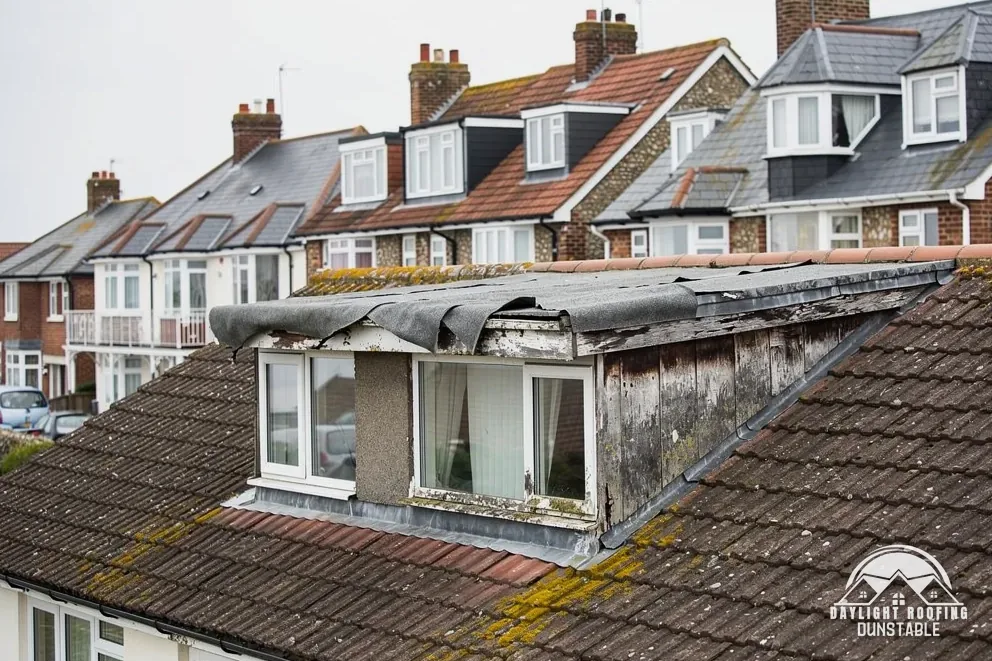
The worn felt roof and cheeks of a box dormer on a chalet bungalow

Lacey Green terms, made plain

Fixing specification
A written plan, specific to the site, for how a roof covering is fastened.
Dry-fixed ridge
A ridge held by mechanical fixings and no wet mortar.
Uplift
The wind force that tries to lift a roof covering upwards.
Clip
A small metal strap that holds a tile or slate against its batten.

The plain-as-day roof check

What keeps a Lacey Green roof on: four fixing checks

4 checks about 4 minutes to read

  1. The fixing specification
  2. Dry ridge and hip systems
  3. Verge detail at gable ends
  4. Nails, clips and battens

01 The fixing specification

Marley says BS 5534 minimums "will always be superseded by the generation of a Fixing Specification, which is site specific". In plain terms, how tiles or slates are nailed and clipped is worked out for the roof in question, taking its exposure into account. No single pattern of nails suits every roof, and a covering laid without regard to the site can be underfixed. Compare the pattern of nails or clips at the eaves, where the covering can be seen close up, with the pattern further up the slope; a change from one to the other can show where an earlier repair was made.

Fixings are calculated for the site's exposure, and that calculation belongs to the roof in front of you. On a re-cover, the survey works out the fixing pattern the new covering needs, and the quote reflects the work needed to meet it, with the old fixings and battens judged on their own condition. A roof that has been patched in several different ways over time is hard to judge by eye, which is one reason the survey looks at the whole slope and not only at the damaged tile.

02 Dry ridge and hip systems

A dry-fixed ridge or hip is held by clips and screws on a batten or a support, and no wet mortar is involved. BS 8612:2018 is the current British Standard for these dry-fixed details along the ridge, down the hips and at the gable edges. A dry ridge can be inspected without the mess of crumbling joints, but the fixings still need to be sound and the ventilation parts clear. Ventilation parts, such as the sections that let air through a dry ridge, can clog with debris, so they are checked along with the fixings and not left out.

Marley's wording is firm: "In all cases, ridge or hip tiles should be mechanically fixed to resist the calculated wind uplift force." That rules out a ridge held by mortar alone, and a cracked mortar line is one more reason to look at what is under the tiles. A ridge that has been re-bedded in mortar with nothing else holding it needs a closer look. If an old ridge has already failed, the old bedding is removed and the tiles are refixed on a proper support, so the repair does not repeat the original arrangement.

03 Verge detail at gable ends

The verge is where a roof stops at a gable wall, and it is one of the places where wind can get beneath the covering. BS 8612 covers dry-fixed verge systems, which clamp the edge tiles mechanically. In a traditional verge, the last tiles are bedded in mortar over an undercloak, and the bedding can crack and loosen. Tiles at a verge also have to shed water into the gutter or clear of the wall, so the line of the edge tile matters to the drainage as well as to the wind.

Look from the ground for tiles at the gable that have moved out of line, mortar that has fallen away, or an edge tile that sits proud of its neighbour. MyJobQuote, in figures dated 8 October 2026, says a dry verge system usually falls between £500 and £2,000. Treat that as an outside benchmark; the price for your own gable follows the survey. A gap behind a loose edge tile can also let a bird or an insect into the roof space, so a lifted verge is worth looking at on that account too.

04 Nails, clips and battens

Every tile or slate is held by a nail, a clip or both, into a timber batten, and the batten is nailed to the rafter. The weak links are corrosion of the nails, splits in old battens and clips that have lost their grip. From the loft, with a torch, you can sometimes see the shanks of nails through the underlay and the rust that has built up on them. Use binoculars to look for tiles that lie flat against the batten and those that have lifted at the lower edge; a lifted tile has lost its fixing.

Marley says installing to BS 5534 "isn't required by law", and that since the 2015 amendments mortar "could no longer be relied upon as the only means of securing the roof covering". Even so, the code is the recognised standard for slating and tiling. BS 5534:2014+A2:2018 is the current edition, and a repair or re-cover that follows it can be explained step by step. Where the battens are the problem, the covering has to come off to replace them, so the battens get checked before anyone chooses between repair and re-cover.

The dashed ring takes in the nearest towns and villages we cover around Lacey Green. Map tiles © Esri; map data © OpenStreetMap contributors.

Lacey Green roof questions, about fixings and more

01Who works out how the tiles on a Lacey Green roof are fixed?

The answer sits in a document, the fixing specification, worked out for each individual roof. Marley's technical advice is that the BS 5534 minimums "will always be superseded by the generation of a Fixing Specification, which is site specific". A neighbour's roof is therefore a poor guide, since exposure and construction can differ from house to house. The survey finds out what is on the roof today and what a re-cover would need, and what follows is a single written total. Describe the roof when you ring: the covering, the age if you know it, and any previous repair.

02Does a Lacey Green roof job go to the Chilterns Board for a decision?

No. The designation affects which planning rules bear on certain roof alterations, but the decision stays with Buckinghamshire Council, and the Board's part is to advise and to respond to consultations. Our planning permission guide lists the rules in one place, so work out which job you have in mind (re-covering, fitting a roof window or enlarging the roof), and read the matching part before you phone the council about your address. Write down the question first, so that the answer can be kept alongside the quote.

03How do the Lacey Green and Loosley Row designations touch a roof job?

Buckinghamshire Council designated both the Lacey Green Conservation Area and the Loosley Row Conservation Area. For the exact lines, the council holds the plans, so when you ring, ask two things in one call: whether your house falls inside either area, and whether an Article 4 direction touches the property. A new covering that changes how the roof looks from the lane is worth raising first, before anything is ordered. If the council gives its answer by email, keep the email.

04Which consent applies to repairs at St John the Evangelist church?

St John the Evangelist, a Grade II building first listed on 21 June 1955 (entry 1125865), belongs to the Church of England. While the church is in use, the faculty jurisdiction of the Church of England takes the place of listed building consent. Lead replaced with matching lead is among the repairs the archdeacon's written notice can cover instead of a full faculty. Planning permission is a separate matter, so the council is asked too. Whichever route the church follows is the route any contractor works to.

05What does a Grade II* listing mean for the windmill?

The windmill is Grade II* (list entry 1159021, first listed 26 April 1985), a grade above Grade II. Consent is wanted for work that would be done "in any manner which would affect its character as a building of special architectural or historic interest", and that includes the roof. Well Cottage (entry 1125866, first listed 26 April 1985) and Stocken Farmhouse (entry 1332010) are Grade II, with the same test applied. A change of covering material is the kind of alteration that tests that line, whereas a matching repair tests it less sharply, and the council can say which your roof needs.

06Is Grim's Ditch near Lacey Green a problem for roof work?

Part of Buckinghamshire Grim's Ditch, an earthwork near Lacey Green, is a scheduled monument (entry 1020885). House roofs are not part of it. Work on scheduled land is regulated separately: the Secretary of State grants scheduled monument consent, with Historic England receiving the requests. That regime is distinct from listed building consent. Keep scaffold, skips and plant off scheduled land until consent exists, and ask before any ground is disturbed. The rule is the same whatever the size of the job, so even a small repair near scheduled land is raised first.

07Is BS 5534 a legal requirement for a re-roof?

No. Marley says installing to BS 5534 isn't required by law, but it remains the recognised code of practice, and BS 5534:2014+A2:2018 is the current edition. Since the 2015 amendments, mortar alone is no longer relied on to secure the roof covering. Building Regulations are a separate question: a re-roof of the whole roof reaches beyond the Planning Portal's tests, so approval applies, and we check the route with the council's building control service before work starts. A heavier covering also raises a structural question, and a structural engineer or surveyor is asked before a new covering 15 per cent or more heavier goes on.

08What might a ridge or verge repair cost around Lacey Green?

A new ridge tile is £80 to £300 on Which?'s November 2025 survey of 11 Trusted Traders, excluding VAT. MyJobQuote gives an average of £225 to £550 for replacing ridge tiles in 2026, and says a dry verge system usually falls between £500 and £2,000. Those ridge figures do not cover hips, which are priced after the survey. These are national ranges; the figure for your roof follows the survey, as one written total. A written total is for one roof, so set it beside any published range with that in mind.

09Who deals with the scaffold licence for a Lacey Green roof?

For a frame on the road or footway, Buckinghamshire Council, the highway authority, is the licensing body, and only a registered scaffolding company can be granted the licence. Buckinghamshire Council charges £402.78 for 28 days, £69.09 to renew and £777.63 retrospectively. We arrange the licence with our scaffolder. A frame that stands wholly inside a private drive or garden does not obstruct the highway, so it needs no licence. Mention at the survey that the work may overrun 28 days, so the renewal can be planned.

Get a written price for your roof

10-year workmanship guarantee, in writing

Tell us about your roof

Call WhatsApp Written quote