
Call 01582 935272

Radnage · 25 road miles south-west

Roofers in Radnage

Clay-tile roofs, eaves timbers, fascia boards and ridge ends around Radnage, looked over before any quote and then priced as one written total.

Get a written quote

Call 01582 935272WhatsApp us

Council
Buckinghamshire
Road miles
25
Building control
Buckinghamshire Council

St Mary's, Charity Cottages and Radnage roofs

Radnage is a village in Buckinghamshire, 25.2 road miles south-west of Dunstable; plan on 49 minutes for the drive. Radnage parish had 707 usual residents at the 2021 Census. Planning applications for Radnage go to Buckinghamshire Council, which also runs its own building control service. Radnage lies inside the Chilterns National Landscape. The Chilterns Conservation Board gives its views through consultation replies, but the council is the decision-maker. Stokenchurch has a conservation area nearby, and Article 4 entries are recorded round the village.

St Mary's Church is Grade I, the highest listing grade, and cottages and a farmhouse in the village are Grade II. A roof here can be a question of what the building is before it is a question of how it leaks. For a house with no listing, a survey comes first, then a plain statement of what the tiles, timbers and junctions need, then one written price. Re-covering is new roof work, and the edge boards fall under guttering, soffits and fascias.

  1. 01Church of St MaryGrade I (entry 1310495, first listed 21 June 1955); the Church of England's faculty route governs work on its roof.
  2. 02Charity CottagesNumbers 1 and 2 are Grade II (entry 1332062, first listed 4 July 1985); roof alterations touching their character need listed building consent.
  3. 03HillsideGrade II under entry 1310484, also first listed on 4 July 1985, so a new covering is a matter for Buckinghamshire Council before work.
  4. 04Town End FarmhouseListed Grade II (entry 1125722); a like-for-like repair is first talked through with Buckinghamshire Council.
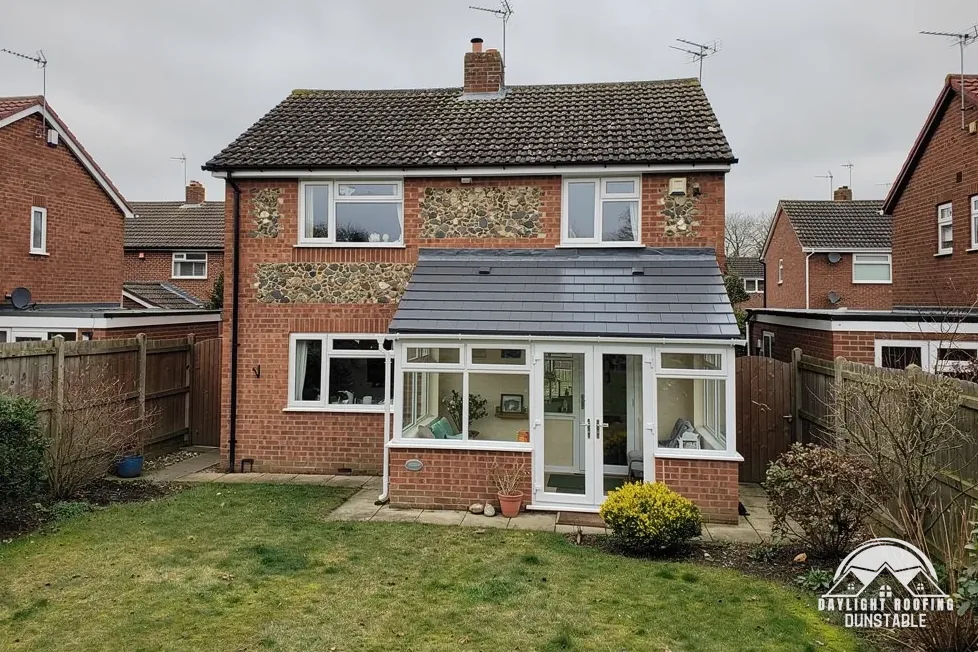
A brick house with a tiled roof and a conservatory at the back

Radnage plain words

Grade I
The highest listing grade, above Grade II* and Grade II.
Wall plate
The beam bedded on top of the wall, where the rafter feet rest.
Spalling
The flaking away of a tile's surface, leaving a rough face.
Completion certificate
The paper a council's building control gives when Building Regulations work is finished.

The plain-as-day roof check

Four places to look on a Radnage clay roof

4 checks about 3 minutes to read

  1. Tile faces and edges
  2. Wall plate and rafter feet
  3. Wood or plastic roofline
  4. Ridge ends at the gable

01 Tile faces and edges

A clay tile weathers, and the weathering shows on its surface. Look for tiles whose faces have flaked away, a process called spalling, leaving a rough, pale or crumbling surface, for hairline cracks running across a tile, and for corners that have broken off. A tile that has lost its face holds water, and in a hard frost the water can split what is left. The ground below the eaves, or a flower bed beneath a lean-to, can show the pieces, and a handful of tile chips on a path is worth a look up.

Marley says the BRE determined a minimum life expectancy of 60 years for clay roof tiles, and HomeBuilding gives 60-80 years for clay. Those are figures for the material, and they do not set a date on which your roof expires. The survey reads each slope's condition tile by tile, course by course, so a roof that is old but sound is left alone and a young roof with failed fixings is not, and the quote reflects what each slope actually needs.

02 Wall plate and rafter feet

At the eaves, the rafters sit on a long timber laid along the top of the wall, known as the wall plate. A failed gutter, or a gap in the lowest tile course, lets water run down onto it, and timber that stays wet will decay. From a ladder-free position, look for a dark stain on the brick below the eaves, a fascia sagging towards one end, or a gap along the join of roof edge and wall.

If the rafter feet or the wall plate are decayed, the repair needs a carpenter's skills alongside the roofer's: the rotten length is cut out and new timber is fixed alongside sound wood. That is a smaller job when found early than when a whole eaves line has dropped, and it keeps the gutter and the first row of tiles in their proper place. A bowing fascia board is an outward clue, though by then the timber behind it may have been wet for a long time. Photographs of the wall below the eaves, taken in daylight with the gutter in view, help a survey find the right spot first time, and a note of how long the stain has been there helps too.

03 Wood or plastic roofline

The roofline is the fascia, soffit and bargeboards, the boards that frame the roof's edge. Timber ones need paint and can rot; plastic ones need less upkeep. A retailer says uPVC fascia boards "can typically maintain reliable performance for between 20 and 40 years" when installed correctly, a figure from a seller, not a measurement of your boards. Soft, flaking or split boards, or paint that has lifted in sheets, are the signs to look for, along with a gap at a mitred corner where the weather can get in.

On a listed building, or in a protected area, the choice between timber and plastic is a point to put to Buckinghamshire Council before anything is bought. Whichever is chosen, the boards carry the gutters, so the fall and the brackets are fixed at the same time, and a gutter hung on a sound board stays where it is put. Roofline work is therefore priced as one job, with the gutters hung level on sound boards.

04 Ridge ends at the gable

Where the ridge runs out over the gable wall, it stops at a special tile or a mortar cap, and that end is worth its own look. Look at it with binoculars: the end tile should sit firmly with no gap beneath it, and the mortar should be intact. A cap that has come loose can drop onto a path, and a gap lets rain behind the last tiles of the ridge, where the bedding is hard to see from below.

Fixings, not mortar alone, hold ridge and hip tiles down against uplift in the wind. The gable end is therefore re-fixed, not simply re-pointed, when it fails. If you can see a loose cap from the ground, keep clear of that corner and send us a photograph on WhatsApp. A survey then confirms how far along the ridge the problem runs.

The dashed ring takes in the nearest towns and villages we cover around Radnage. Map tiles © Esri; map data © OpenStreetMap contributors.

Radnage roof questions, each answered in full

01How do I decide between repairing and replacing a Radnage clay-tile roof?

Judge the condition, not the age. For clay roof tiles, Marley reports that the BRE determined a minimum life expectancy of 60 years, and HomeBuilding gives clay tiles 60-80 years. Those figures describe the material and do not set a date for your roof. A roof with a few cracked tiles and sound fixings is repaired; one whose tiles are spalling across whole slopes, or whose battens have rotted, is re-covered. The survey says which, and the written price follows from it. Where a roof is part-way between the two, the survey sets out what a repair would achieve and what it would leave untouched, so the choice is made on facts.

02How are repairs to St Mary's roof authorised?

St Mary's, a Church of England church, is Grade I (list entry 1310495, first listed 21 June 1955). While it remains in use for worship, the faculty system stands in for listed building consent, and some like-for-like roof repairs (List B) require nothing beyond the archdeacon's notice in writing. Planning sits on a separate track: external work may still require planning permission from Buckinghamshire Council, so that question is put to the council as well. A faculty application proceeds on its own timetable, apart from any roofing survey.

03Besides the church, what else is listed in Radnage?

Hillside (entry 1310484) and Numbers 1 and 2 Charity Cottages (entry 1332062) were both first listed on 4 July 1985 and carry the same grade, and Town End Farmhouse has entry 1125722; each is Grade II. Alterations affecting their character call for listed building consent, so Buckinghamshire Council is asked before work starts on any of their roofs. The council can quickly confirm whether your own house is listed, and a neighbour's listing does not decide it. If you are unsure, quote your address and ask, then keep the answer with the quote, because nobody should have to guess whether a roof is listed.

04Inside the Chilterns National Landscape, who decides on a dormer?

The council does: the application goes to Buckinghamshire Council, which decides it. The Board advises, and much of its influence comes from replying to consultations. For a dormer or any other work that alters how the roof is shaped on a Radnage house, whether it is a first plan or a change to an old dormer, our planning permission guide sets out how the rules run. The Board's notes say flint "is often combined with brick" in older buildings and boundary walls, a description of old buildings, not a rule for yours.

05Does the Stokenchurch conservation area reach Radnage houses?

It is nearby, and nearby is a different thing from inside. Stokenchurch is the conservation area named close to the village, and for the position of one particular house, Buckinghamshire Council is who to ask. Article 4 entries are recorded round the village too, and the council must say what each of them removes. A different covering, or a fresh opening cut into a roof slope, belongs in a question to the council before you order, with the answer filed alongside your quote.

06What does scaffolding mean in licence terms for a Radnage job?

On a carriageway or footway the licence for poles and boards is Buckinghamshire Council's to give, as the highway authority, whose fees are £402.78 for 28 days, £69.09 to renew and £777.63 when the licence comes after the scaffold. Buckinghamshire Council's wording is: "You must be a registered scaffolding company to apply for a licence." We arrange the licence with our scaffolder. Where a lane has no verge, the frame's position is fixed at the survey, and a narrow lane may call for a shorter stay.

07Who can sign off a re-roof: the council or a private firm?

Building control is carried out by the council's building control team or by a registered building control approver. For Radnage the council's team is Buckinghamshire Council's own service. A council's building control gives a completion certificate when the work is done; a registered approver gives a final certificate. The registration scheme for approvers is what is new, starting on 6 April 2024; private building control existed before it, and the older arrangement had a different title for the same private role. Either body can be asked what a full re-roof needs.

08Could a zinc roof suit a small Radnage extension?

It can be an option for a modern extension, and an extension roof is a place where a low pitch makes some other coverings awkward. VMZinc, the maker, says "When correctly designed and installed a zinc roof can last in excess of 100 years." That is a manufacturer's statement about correct design and installation, not a promise for a given roof, and it is a statement about zinc, not about any other metal on a roof, which has its own record. In a listed building or a protected area, a metal covering is a point for Buckinghamshire Council to hear before any order is placed, and a survey decides whether the structure beneath is suited to it.

09How long should uPVC fascia boards last?

One retailer says that when installed correctly uPVC fascia boards "can typically maintain reliable performance for between 20 and 40 years". That is a seller's claim and not a promise, because performance depends on how the boards were fixed and what has hit them since, and a board that has been knocked, drilled or badly fitted can fail sooner. Timber boards need regular paint and can rot where water sits behind them. Either way, a gutter bolted to a weak board will not hold its fall, so the board's condition comes first.

Get a written price for your roof

10-year workmanship guarantee, in writing

Tell us about your roof

Call WhatsApp Written quote