
Call 01582 935272

Quainton · 20 road miles west

Roofers in Quainton

Quainton homes with a leak, a worn covering or a failing stack are visited and surveyed, then repaired or re-covered on a single written total, with leadwork and gutters included in the look.

Get a written quote

Call 01582 935272WhatsApp us

Council
Buckinghamshire
Road miles
20
Conservation area
Quainton
Building control
Buckinghamshire Council

Roof work near Quainton's Market Cross and standing cross

Quainton is a village west of Dunstable, 20.1 road miles away in Buckinghamshire, which is a journey of about 37 minutes. At the 2021 Census, Quainton parish had 1,312 usual residents. Buckinghamshire Council receives the village's planning applications, and building control runs from there too, with a page on its website for contacting that team. Buckinghamshire Council has designated a conservation area at Quainton, so an alteration that changes what the street sees of a roof is worth raising with the council before it is planned. An Article 4 direction can remove further permitted development rights, so we check with the council first. Re-roofing, roof lights and dormers each have their place in the planning permission guide.

Among the listed buildings in Quainton named in the National Heritage List are the Church of St Mary and the Holy Cross (Grade I, entry 1319285), the Market Cross (Grade II*, entry 1117825) and Cross Farmhouse (Grade II*, entry 1319249). The Quainton medieval standing cross is a scheduled monument near the village. Surveying comes ahead of pricing, and any other faults noticed are reported to you along with the answer.

  1. 01Parish church, Grade IChurch of St Mary and the Holy Cross (entry 1319285, first listed 21 December 1967): Church of England, and a faculty matter for its roof.
  2. 02The Market CrossGrade II* (entry 1117825), and also first listed on 21 December 1967.
  3. 03Cross FarmhouseGrade II* (entry 1319249). A changed covering, a new ridge or a rebuilt stack needs a conversation with the council first.
  4. 04The medieval standing crossA scheduled monument (entry 1015267), protected in its own right and handled through a separate consent route.
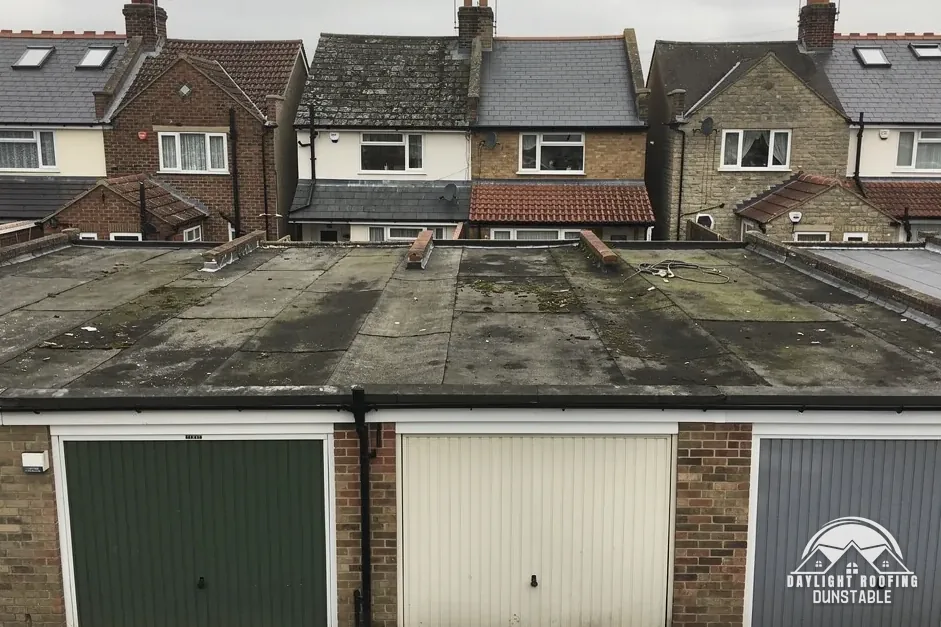
Row of flat-roofed brick lock-up garages with worn felt

The roof, in plain words

Eaves tray
A strip that guides water from the underlay into the gutter.
Wall plate
The timber on a wall head that bears the rafter feet.
Stack cap
A slab or cover on top of a chimney stack.
Like for like
A repair that puts back the same material in the same place.

The plain-as-day roof check

Four things worth checking on a Quainton roof

4 checks about 3 minutes to read

  1. Eaves trays and underlay edges
  2. Rafter feet and wall plates
  3. Swapping a roof window
  4. Stack caps and flues

01 Eaves trays and underlay edges

At the bottom of a slope, the underlay has to deliver water into the gutter and not behind it. A strip called an eaves tray supports the underlay's edge and carries water across the fascia into the gutter. Look from the ground for a gutter that sits too far from the wall, for a dark line on the fascia board where water has run behind and for tile ends that overhang the gutter by a visible margin. If you can see the underlay edge from a ladder-free angle, such as an upstairs window, photograph it.

Where the underlay's edge sags into the gutter or lies on the fascia, water can wick into the timber and rot it. That kind of fault can show as peeling paint on the board. The guttering, soffits and fascias page covers the boards, and how the underlay is dressed at the edge is part of the survey.

02 Rafter feet and wall plates

Where the roof timbers meet the wall, the rafter feet sit on a length of timber known as the wall plate. A leaking gutter or a failed eaves can wet that junction for years without any sign inside the house. From the hatch, sweep a torch along the eaves: dark staining, soft timber when pressed with a screwdriver tip and a smell of damp are all reasons to say so at the survey. A note of which wall the damp is on helps pinpoint the leaking section of gutter.

Do not lean out beyond the joists to see further. A photograph taken at arm's length with a phone pointed down the slope is safer, and it shows the timber clearly enough for a first view. Decay at the rafter foot is a structural repair and sits outside a simple re-tile, which is why no written total is given over the phone, only after the survey. If the roof has been re-tiled before, ask whether the timbers were checked then.

03 Swapping a roof window

Replacing a roof window with one of the same size is easier than cutting a new opening, because the flashing and the trimmed rafters are already in place. For a standard mid-range Velux, the average MyJobQuote gives is £1,100 (page of 22 September 2026), and a like-for-like swap comes in about £100 lower. A new roof window also changes the finish inside the room, so the surround is part of the job.

Approved Document L treats a roof window as a unit in the same orientation as, and in plane with, the surrounding roof; the limit is 1.4 W/m2K, or Window Energy Rating Band B. A rooflight on a kerb is held to 2.2 W/m2K. Check which you have before choosing a replacement, since the two are different products with different figures. Mention the make or the age of the existing window if you can read it on the frame.

04 Stack caps and flues

A redundant stack should still have a cap that keeps rain out and a vent that lets the flue breathe. From the road, check for a cap that has cracked, a flue opening that is bare to the weather and plant growth on the top. Stains on the chimney breast inside are the sign of rain getting down the flue. Birds sometimes nest in an open flue, which is a further reason to look before the stack is disturbed.

Removing a chimney breast always needs Building Regulations approval, because it is part of the structure. MyJobQuote's lead flashing page, dated 22 September 2026, says a patch repair to chimney lead typically costs around £200 while a full replacement averages around £570. That scope is chimney leadwork alone. The chimney repairs page covers capping and rebuilding. Capping a stack that is not in use and ventilating the flue is a separate job from rebuilding one.

The dashed ring takes in the nearest towns and villages we cover around Quainton. Map tiles © Esri; map data © OpenStreetMap contributors.

Roof questions for Quainton homes

01What is listed in Quainton, and how does that reach a roof?

The Church of St Mary and the Holy Cross (entry 1319285, first listed 21 December 1967) holds a Grade I listing; as a Church of England church in use, it follows the faculty system rather than listed building consent. The Market Cross (entry 1117825) and Cross Farmhouse (entry 1319249) are Grade II*. Consent under the Planning (Listed Buildings and Conservation Areas) Act 1990 is needed where work alters a listing's character, and the covering, the ridge and the stacks may each be part of that character. Put the plan to Buckinghamshire Council, quoting the entry number so that it knows which building is meant. A listed building can also be in a conservation area, and the two sets of controls apply together. Dated pictures showing the roof today give a baseline for any later discussion.

02Does Quainton's conservation area change a roof repair?

Buckinghamshire Council designated the conservation area at Quainton, and it can say if your address falls within it. A like-for-like repair is one thing and a change to the roofline another, so describe your plan to the council before you commit to a contractor. Permitted development rights are stricter in a conservation area. The planning guide explains the roof rules, and the council holds the answers about your own street. If you are unsure whether your home is also a listed building, the council can confirm that at the same time. Ask the council for its answer in writing, since a verbal reply is hard to show to a contractor later.

03What is an Article 4 direction?

GOV.UK describes an article 4 direction as a direction under article 4 of the General Permitted Development Order which enables the Secretary of State or the local planning authority to withdraw specified permitted development rights across a defined area. For a roof, that can matter, which is why we check with the council first. The reply for your address comes from Buckinghamshire Council, and a written answer is worth keeping with any quote for the work. A direction is specific to a place, so a neighbour's answer may not be yours. The answer can differ between two houses in the same lane if only one sits inside a designated area.

04What is the standing cross, and does it matter to roofs?

The Quainton medieval standing cross is a scheduled monument (entry 1015267) near the village. Authorised works only: the Secretary of State grants scheduled monument consent, and requests go to Historic England. That protection belongs to the monument. Roof work on a house in the village goes through the council instead, and the list entry tells you the monument's name and number, which is how to find it. The monument is listed by name, not by where your house stands in relation to it.

05Does Quainton need a scaffold licence for roof work?

Where a scaffold would obstruct a street, section 169 of the Highways Act 1980 calls for a licence, and the licensing authority is Buckinghamshire Council. The page of Buckinghamshire Council states: "You must be a registered scaffolding company to apply for a licence." Its charge is £402.78 for 28 days, with £69.09 to renew and £777.63 for a retrospective licence from Buckinghamshire Council. We arrange the licence with our scaffolder, and scaffold costs are in the written quote, which keeps everything in a single document. A scaffold that stays entirely inside your own boundary needs no highway licence.

06What does gutter replacement cost?

On a page dated 20 October 2026 MyJobQuote averages gutter replacement across the UK at around £1,000 to £1,600, and on a page dated 17 September 2026 it averages capping fascias and soffits at around £800. Which? Trusted Traders give £75 to £350, excluding VAT (November 2025), for a full gutter clear-out at both the front and the rear. The three figures come from different pages and describe different work. The total we write for your house comes once the whole run has been surveyed, and it covers the fall, the brackets and the outlets. Brackets and outlets are part of any sound gutter run.

07What does replacing a garage roof cost, and is asbestos a worry?

MyJobQuote says in 2026 the average garage roof replacement costs between £750 and £3,500 (page dated 26 October 2026). Corrugated sheets can be asbestos cement. HSE advises treating any building built or refurbished before 2000 as containing asbestos, and says asbestos cement roofs are always fragile. HSE's answer for waste is a lockable skip. MyJobQuote gives the average cost of an asbestos survey as around £325 in 2026. If sheets are intact and unbroken, the position is different from one with a cracked or crumbling sheet, and a test can say which you have.

08How long does lead flashing last?

MyJobQuote says correctly installed lead flashing can last for over 80 years, and over 100 years for higher codes with minimal maintenance. Those are statements about lead that is correctly installed. A flashing that has lifted, split at a fold or slipped from its chase is no longer correctly installed, whatever its age. Rolled lead is made to BS EN 12588 in codes 3 to 8, and the specification sets the code for each detail. Check the flashing on both sides of the stack, since a flashing that has failed on one side only can stain a single wall. Lead that is dull and uniform in colour with intact folds is doing its job, while bright, cracked lead is not.

09What helps most when I describe a leak by message?

Say where the stain is indoors, which slope is above it and when it appears, for instance after wind and rain or only in heavy showers. Attach two photographs, one close and one wide, to WhatsApp on 07880 284133, or ring 01582 935272. Those details tell us what to look for at the survey. A written total price follows after the survey, because only a look at the roof shows what the water has been doing. Dates matter, so say when you first saw the mark.

Get a written price for your roof

10-year workmanship guarantee, in writing

Tell us about your roof

Call WhatsApp Written quote