
Call 01582 935272

Steeple Claydon · 26 road miles west

Roofers in Steeple Claydon

Tile repairs, flat and garage roofs, leadwork and spray foam questions for Steeple Claydon houses, each ending in one written price, with St Michael's Grade II* listing kept in mind.

Get a written quote

Call 01582 935272WhatsApp us

Council
Buckinghamshire
Road miles
26
Building control
Buckinghamshire Council

Roofs on North End Road and round St Michael's

Steeple Claydon is a Buckinghamshire village lying west of Dunstable, 25.8 road miles away and about 44 minutes by road. The 2021 Census counted 2,527 usual residents in Steeple Claydon parish. St Michael's church is listed Grade II* (entry 1214937, first listed 13 July 1966), and the village's Grade II listings include The Milk Pail (entry 1288313) and 10, North End Road (entry 1288355), both first listed on 13 February 1984, and Vine Cottage (entry 1214896). A roof beside any of them gets its list entry read before a covering is chosen.

Buckinghamshire Council takes the village's planning applications. Conservation areas lie close by at Middle Claydon and Church End; neither is placed over Steeple Claydon itself, and a street address is a matter to check with the council. No figure is put on the roof until it has been surveyed, and the written total that follows comes with a plain account of any other fault found up there.

  1. 01Church of St MichaelA Grade II* Church of England church in use, so work on its roof goes by the faculty route and not listed building consent.
  2. 02The Milk PailListed Grade II (entry 1288313) in February 1984, so changes to the roof are weighed against the list entry first.
  3. 0310, North End RoadListed Grade II (entry 1288355), so a new opening or different covering needs the listing question answered beforehand.
  4. 04Vine CottageListed Grade II (entry 1214896), so repair methods and matching materials are raised with the council before work.
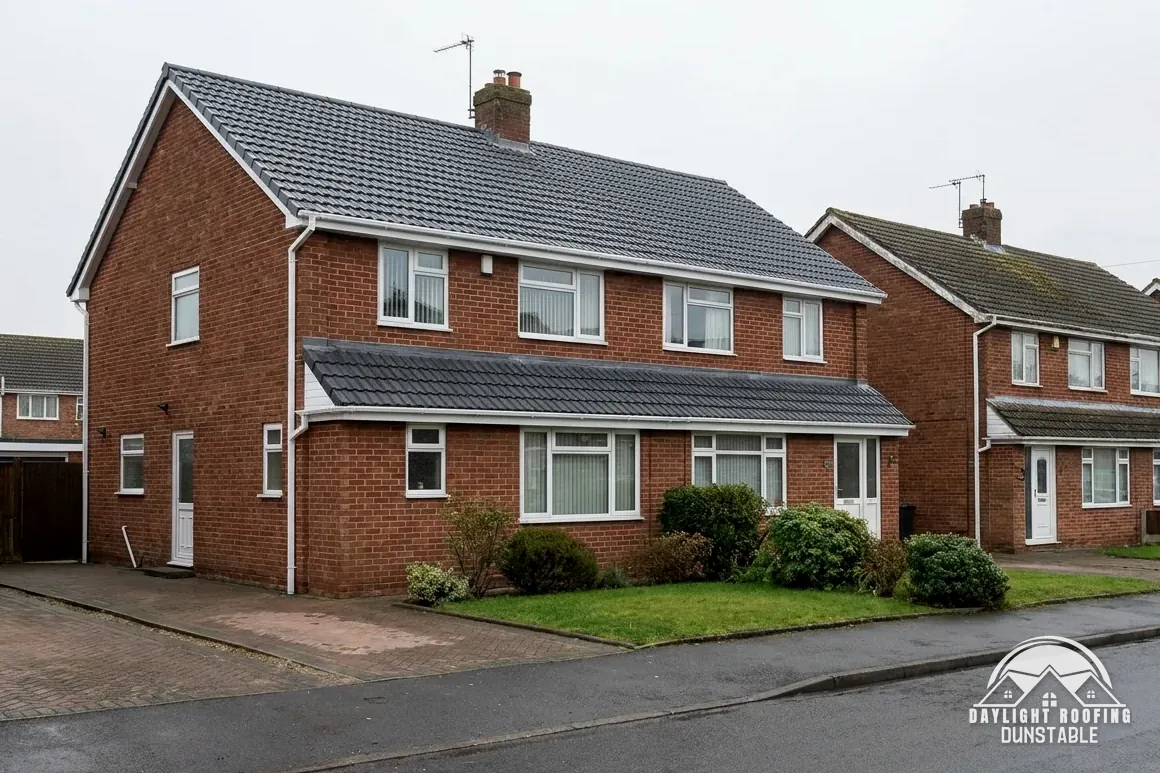
Brick semi-detached houses with new grey tiled roofs

The roof, in plain words

Asbestos cement
A hard grey sheet once used for garage and shed roofs.
Spray foam
Insulation sprayed onto the underside of the roof slope.
Lead code
A number from 3 to 8 giving the thickness of rolled lead.
Faculty
The Church of England's own permission route for work to its churches.

The plain-as-day roof check

Four Steeple Claydon roof matters worth knowing before a quote

4 checks about 3 minutes to read

  1. Garage and outbuilding sheets
  2. Spray foam under the slope
  3. Lead on flat roofs and bays
  4. A few tiles gone astray

01 Garage and outbuilding sheets

A corrugated sheet roof over a garage or store raises one question before any other: is it asbestos cement? HSE's rule of thumb is "If the building was built or refurbished before 2000, assume that there is asbestos in it." HSE adds "AC roofs are always fragile", which is why nobody should step onto one to look. The rules split by condition. Cement sheeting taken down carefully, without being broken, is non-licensed work, while sheeting "where the material has been substantially damaged or broken up" is notifiable non-licensed work. A repair that leaves an old sheet roof in place is a different job from replacing it, so the starting point is identifying what the sheet is made of, and whether the roof can safely be reached at all.

Three of MyJobQuote's 2026 pages are relevant, each with its own date: an average range of £750 to £3,500 for a garage roof replacement, an average of around £2,750 to take asbestos off a roof, and around £325 for an asbestos survey. Waste goes in a lockable skip, and HSE's own wording is "it is not good enough to throw sheeting over a standard skip". The sheets are removed whole, not smashed.

02 Spray foam under the slope

Foam sprayed to the underside of a slope sits tight against the rafters and battens, so the timbers cannot be seen. The RICS consumer guide warns that "If the timber roof structure is covered with spray foam it cannot be fully seen or inspected". On finance, RICS reported in March 2023 "concern within specific sectors of the lending market, such as equity release mortgages", while the Energy Saving Trust says foam "doesn't automatically prevent you from getting a mortgage, but some lenders may ask for extra checks". On the separate risk of timber rot, the Trust adds: "But this risk should be much lower with open-cell foam."

Checkatrade's July 2026 guide says that for a three-bedroom detached house the total roof foam insulation removal cost comes to "around £3,200", and that removal "typically runs between £50 and £75 per m² for open-cell foam". MyJobQuote's average is "£40 per m²". Those are rates and examples from separate pages, and none of them is a total for another roof. Government guidance from 22 October 2026 says removal "will not always guarantee that they will still lend", so a lender and a specialist surveyor are consulted first. The lender question has a plain starting point, which is the lender's own policy.

03 Lead on flat roofs and bays

Rolled lead sheet to BS EN 12588 comes in codes 3 to 8. Code 4 measures 1.80 mm and is 20.41 kg/m² by both Calder's and Ecobat's charts; code 3 differs between them, at 14.97 for Calder and 15.0 for Ecobat, which is why a weight goes with the maker's name. Which code suits a detail is set by the specification.

For a lead flat roof, HomeBuilding's figure is 60-100 years, while Less writes "Lead is the longest-lasting option at 50 to 100 years". The two ranges overlap but are not the same. BS 6229:2025 covers membrane flat roofs, not lead. Look at the lead round a bay window or a porch from the ground for splits at folds and for staining below. More is under lead roofing and leadwork. On a bay, the junction where the flat top meets the main slope is the line to watch, because water entering there runs down inside the bay wall and shows as damp well below the roof.

04 A few tiles gone astray

A handful of slipped or missing tiles is a repair, and access and tile type shape the price. In the Which? Trusted Traders survey, replacing between one and six standard tiles costs £75 to £400 (November 2025, excluding VAT). MyJobQuote's 2026 average for a roof repair is around £650, and for replacing roof tiles around £215. A written total for a tile repair covers access to the spot, the tiles and the fixing, and it follows once the survey has viewed the roof from close up.

A gap in the covering lets water reach the underlay and battens, which is why a missing tile is not left for another season. Photograph the roof from the ground, note any stain indoors, and send the pictures if that helps. The survey then looks at the surrounding tiles, since a loose one can have neighbours in the same state. Repairs are described under roof repairs.

The dashed ring takes in the nearest towns and villages we cover around Steeple Claydon. Map tiles © Esri; map data © OpenStreetMap contributors.

Steeple Claydon roof questions, straight answers

01Is a damp patch on a Steeple Claydon bedroom ceiling a leak or condensation?

Either, and the pattern tells which. A stain that appears only after rain points to water coming through the covering or round a flashing. Dark spotting spread across the whole underside of the slope, or a damp smell in the loft with no rain-linked stain, points to moisture from the house failing to escape. BS 5250:2021 is the standard that deals with moisture in buildings, and eaves openings feature in it. See whether the insulation has been shoved into the eaves, note where marks sit, and send photographs from the loft and the ground so the survey starts with the right question.

02What approval does St Michael's Church need for roof repairs?

St Michael's is a Church of England church in use and is listed Grade II* (entry 1214937), which puts its roof under the church's own faculty process in place of listed building consent. List B in the Faculty Jurisdiction Rules 2015 includes renewing roof lead in kind, which needs only written notice from the archdeacon that the work may go ahead. Planning permission for outside alterations is a separate matter, answered by what the work involves. None of this applies to an ordinary house, whose roof is judged by the council and the building regulations tests.

03Does a Grade II listing at The Milk Pail or Vine Cottage change roof repairs?

Listing leaves permitted development rights in place, but anything done "in any manner which would affect its character as a building of special architectural or historic interest" needs listed building consent. The Milk Pail (entry 1288313), 10, North End Road (entry 1288355) and Vine Cottage (entry 1214896) are each listed Grade II. Mending a roof with matching material and changing to something new land differently, and Buckinghamshire Council can say where a particular job falls. Ask it before ordering materials, not afterwards. The council's answer applies to the individual building, so what happened to a neighbour is no guide.

04Do the conservation areas at Middle Claydon and Church End reach a house in Steeple Claydon?

They lie close by, but whether a particular address lies within either is confirmed by Buckinghamshire Council. An Article 4 direction can remove further permitted development rights, so we check with the council first. For the planning side, the planning guide sets out when roof work needs an application, and the council has the last word on a named address. The roof is surveyed in the same way wherever it stands, and the council check runs alongside. Asking early costs a short enquiry; asking late can cost a restart.

05Who applies for scaffold licences in Steeple Claydon, and how much do they cost?

Buckinghamshire Council licenses scaffolds that stand on a highway, and its schedule reads £402.78 for 28 days, with a renewal at £69.09 and a retrospective licence at £777.63. Buckinghamshire Council also says "You must be a registered scaffolding company to apply for a licence." That is why the householder is not the applicant. We arrange it with our scaffolder. The scaffolding this job requires is costed into the Steeple Claydon written quote, and the household makes no application of its own.

06What does an insurer look for after storm damage to a Steeple Claydon roof?

Evidence. The Financial Ombudsman Service says it will "usually look at expert reports and photos", and "The insurer has to prove that the exclusion applies - for example, with an inspection report." It also says "Rain, hail or snowfall by itself can constitute a storm". Photograph the damage first, before moving anything, and keep broken pieces for the insurer to see. If a claim is refused, "For most complaints, a business has up to 8 weeks to consider a complaint" before the Ombudsman can take it up. Dated photographs and notes made at the time make a claim far easier to support than recollection.

07Who looks after safety on a Steeple Claydon roof job under the CDM rules?

On a home project the owner is a domestic client, and the client duties move across to the roofing contractor. Regulation 7 of CDM 2015 hands them to "the contractor for a project where there is only one contractor"; where several contractors are involved the duties sit with the principal contractor instead. A construction project of this kind needs "a construction phase plan", which a lone contractor draws up. HSE defines the domestic client as a person whose home is the subject of the building work and who is not acting in the course of any business, which fits a householder ordering a re-roof.

08Does the VAT rate on loft insulation change while a Steeple Claydon roof is re-covered?

HMRC's Notice 708/6 gives a zero rate to insulation fitted in roofs or lofts where installations are "made between 1 May 2023 and 31 March 2027", and from 1 April 2027 the reduced rate of 5% applies. The relief covers energy-saving materials and does not extend to roof repairs as a whole. A VAT question about a particular job should be put to us or to HMRC and not worked out from a general rule, since the answer depends on what is being installed. Insulating the loft as part of a re-roof is a decision for the owner, and the roof's condition is looked at before any insulation is laid.

09What decides the cost of a new roof on a Steeple Claydon house?

Several things play a part: how the roof is reached, its size and shape, the covering chosen, and what the survey finds underneath. For outside context, MyJobQuote averages a new roof at around £5,250 across the UK (page dated 3 November 2026). Separately, Which? Trusted Traders give £7,000 to £21,000 excluding VAT for an average three-bedroom house. The sum that reaches the customer is a single written total, worked out after the survey; a listing or a heritage designation near the address can call for a consent step beforehand.

Get a written price for your roof

10-year workmanship guarantee, in writing

Tell us about your roof

Call WhatsApp Written quote