
Call 01582 935272

Watlington · 30 road miles south-west

Roofers in Watlington

For Watlington, the Oxfordshire market town 29.7 road miles south-west of Dunstable, we repair and re-cover roofs in tile, slate, lead and metal, each job priced as one written total.

Get a written quote

Call 01582 935272WhatsApp us

Council
South Oxfordshire District
Road miles
30
Conservation area
Watlington Conservation Area
Building control
South Oxfordshire

Roofs round the Town Hall and Shirburn Street

Watlington lies south-west of Dunstable, 29.7 road miles off, roughly 54 minutes at the wheel. At the 2021 Census, Watlington parish had 2,699 usual residents, a count the Census makes at parish level. Three Grade II* buildings and one Grade II house are listed below, each with its heritage-list number, and the roof of any one of them is dealt with as part of its listing, with the council involved from the first conversation.

Planning applications from Watlington go to South Oxfordshire District Council. It designated the Watlington conservation area, and the land round the town takes in two more, Shirburn and Pyrton, so for a roof in or near the town the first question is which of the three lines, if any, the address sits inside. The council settles where each boundary runs. Our planning guide covers the roof rules, and the slate roofing page describes work in natural slate, for houses where that covering is already in place.

  1. 01Church of St LeonardGrade II*, National Heritage List entry 1059424, first listed on 18 July 1963, a Church of England church.
  2. 02Watlington Town HallGrade II*, entry 1369012, first listed on 18 July 1963, so the roof is weighed as part of the whole building.
  3. 03East End HouseGrade II*, entry 1369016, first listed on 18 July 1963, raising the same consent questions as the Town Hall.
  4. 041, Shirburn StreetGrade II, National Heritage List entry 1181468, a listed house where the council is asked before roof work.
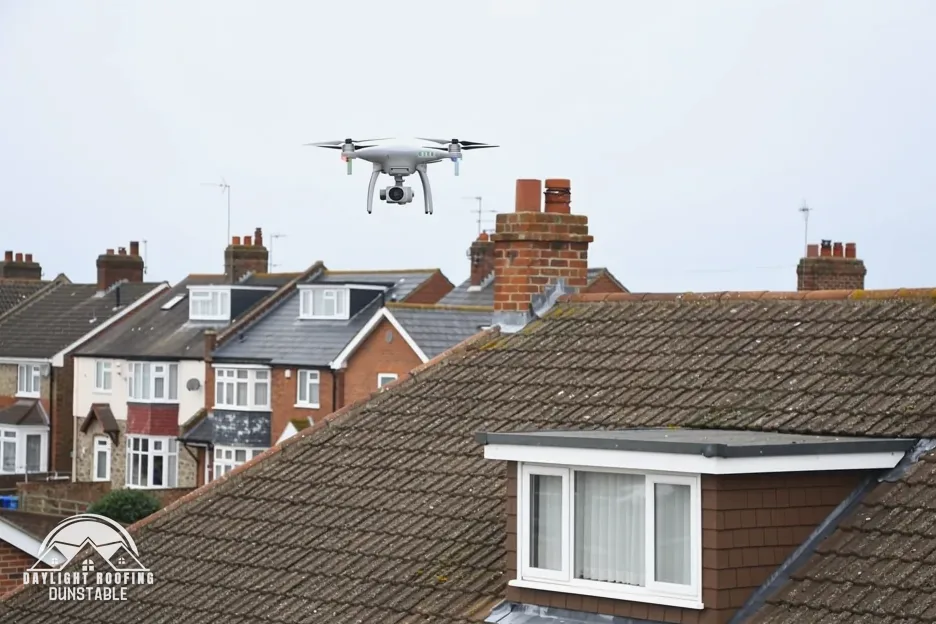
A small grey drone hovering above the tiled roof of a chalet bungalow

Plain words for Watlington's roofs

Lifespan
A published range for how long a covering keeps working.
Standing seam
The raised fold that joins two strips of sheet metal.
Flashing
Lead dressed over the joint where a stack meets the slope.
Grade II*
A listing grade between Grade II and Grade I.

The plain-as-day roof check

How old is a Watlington roof, and how long has it left?

4 checks about 3 minutes to read

  1. Age of the covering
  2. Zinc and other sheet metal
  3. Lead flashing round the chimney
  4. Listed roofs in the town centre

01 Age of the covering

Nobody can read a roof's age from the street, but its condition gives clues: tiles worn thin, slates beginning to flake, a surface scored with fine cracks, or a slope that has needed attention every few seasons. Colour is a poor guide, because moss and weather change it faster than age does. A written record of past work, if the household has one, shows how many repairs the roof has already had, and the date of the last one tells you where the next fault might appear.

HomeBuilding, last updated 30 September 2025, gives approximate lifespans: Welsh slate 100+ years, Spanish slate 75-100, reclaimed Welsh slate 50-80, clay tiles 60-80 and plain concrete tiles 40-50. BRE's published minimum life expectancy is 60 years, and it is stated for clay tiles only. A lifespan range describes a material in general, never a particular roof.

02 Zinc and other sheet metal

Some roofs and dormer cheeks are covered in sheet metal, joined along standing seams. On a zinc roof, check for seams that have parted, patches of white powdery corrosion, a fixing clip showing through, or a stain on the wall under the eave, and note whether the metal has pulled away from the edge trim. Metal moves with changes in temperature, so the junction with a wall deserves a close look as well as the open sheet.

VMZinc, the maker, says a zinc roof "can last in excess of 100 years" when correctly designed and installed, which is a manufacturer's statement tied to the conditions it names. Lead is another sheet metal with its own codes, and the lead roofing page covers it, including the codes set in BS EN 12588.

03 Lead flashing round the chimney

A lead flashing seals a chimney stack at the point where it leaves the roof. Look for lead that has lifted from the brickwork, a gap along its top edge, creases that have split, or a white crumbling line of mortar above it. A brown stain on the breast of a chimney in a bedroom, level with the roofline, may point to a failed flashing, although a failing pot or cracked flaunching above can cause the same stain.

MyJobQuote says correctly installed lead flashing "can last for over 80 years". On chimney leadwork alone, it gives a patch repair at around £200, a full replacement averaging around £570, and £350 to £920 for a full leadwork replacement depending largely on whether scaffolding is required, in a page dated 22 September 2026. Those numbers apply to chimney leadwork and to nothing wider.

04 Listed roofs in the town centre

The roof of a listed building forms part of what the listing protects. From the pavement, note the covering, the ridge, the verge details and the chimney stacks, because the council judges any change against what is there now. Where a new material would alter a listed building's character, the council's consent is needed.

The Town Hall and East End House are both Grade II*. A roofer's survey looks at the condition of the covering and of the roof's junctions with walls, and the council decides what is acceptable. A call to South Oxfordshire District Council about any change, however small, is the sensible first step for a Watlington listed building. Take photographs of the roof from the street first, so the conversation starts from what is actually there, and keep any earlier correspondence about the building to hand.

The dashed ring takes in the nearest towns and villages we cover around Watlington. Map tiles © Esri; map data © OpenStreetMap contributors.

Watlington roof questions, one at a time

01How long might a tiled roof in Watlington run before replacement is due?

Published figures give a range, never a date. HomeBuilding's approximate lifespans are 40-50 years for plain concrete tiles and 60-80 for clay. Those numbers describe materials in general. A particular Watlington roof depends on workmanship, fixings, battens and exposure, and a survey tells you what the roof in front of it needs, with anything else seen up there reported in plain words, ahead of the price. A photograph sent by WhatsApp can start the conversation, though only a visit shows the slopes up close. Roofs on the street frontage and on the rear outbuildings are both included, because the same weather reaches both and each can hide a fault the other does not show.

02Do the Watlington, Shirburn and Pyrton conservation areas affect a re-roof?

Watlington, Shirburn and Pyrton each have a conservation area, and South Oxfordshire District Council designated every one. A house inside any one may meet tighter planning scrutiny of outside work, and the council, not the roofer, says which addresses lie within each boundary, as well as whether any further restriction applies to a plot. An Article 4 direction can remove further permitted development rights, so we check with the council first. The usual rules for a house roof are in our planning guide, and a call to the council before any covering is picked can spare a redesign later, particularly where the roof faces the street.

03What process covers roof work to St Leonard's church in Watlington?

St Leonard's is a Church of England church, listed Grade II* (entry 1059424), and while it stays in use, roof work follows the faculty route under the faculty jurisdiction of the Church of England, in place of listed building consent. A repair doing no more than renewing lead or tiles like for like sits within List B, and the archdeacon's notice in writing then covers it with no full faculty, and the planning question stands apart from it. Whether Watlington exterior work also calls for planning permission turns on how the planning tests apply to the job, so a faculty is one step among several and not the whole route.

04Do the Town Hall, East End House and 1 Shirburn Street have extra roof rules?

They do. The Town Hall (entry 1369012) and East End House (entry 1369016) are Grade II*, and 1, Shirburn Street (entry 1181468) is Grade II. Roof work stays within permitted development for a listed home, though the listed-building rules require consent for works "in any manner which would affect its character as a building of special architectural or historic interest". The council answers that question, and it is put to the council before any design for the roof is fixed, so that the plan starts from a firm answer, not from hope.

05Who arranges scaffolding permission and building control on a Watlington roof job?

For scaffolding on a Watlington pavement or lane, the highway authority is Oxfordshire County Council, whose licence is required, and we arrange the licence with our scaffolder. Building control is South Oxfordshire District Council's building control service. For a re-roof, the Planning Portal's limits include "Less than 50 per cent of the roof is affected", and replacing the whole covering goes beyond it, so Building Regulations approval is needed. The council's building control team answers questions about a specific address, including which route a full re-roof should take. Ask before the work is booked, because approval comes first and the programme follows it.

06What might a roof like a three-bedroom semi's cost in Watlington?

A written total follows our survey, so figures from other sources are the only guide beforehand. HomeBuilding, last updated 30 September 2025, puts a three-bedroom semi with a 65m² roof and plain concrete tiles at a figure that "may cost between £10,000 and £15,000", with Welsh slate for the same property reaching a level that "might reach £18,000". Which? Trusted Traders give £7,000 to £21,000, excluding VAT, for an average three-bedroom house. These come from different surveys of different houses on different dates, so they are not merged into one range here, and none of them is our price.

07Is zinc worth considering for a Watlington extension or dormer roof?

It is one option among several. For VMZinc, the maker, a zinc roof "can last in excess of 100 years" when correctly designed and installed, which is a manufacturer's statement tied to the design and the fitting. Zinc is not a tile roof, and its seams, edges and junctions with walls are the places a survey looks. On a listed building, or one in a conservation area, the council is asked about any change of material before a quote is accepted, since a new metal covering changes the look of a roof and the street it faces.

08What does lead flashing round a Watlington chimney cost to patch or replace?

For chimney leadwork, MyJobQuote gives around £200 for a patch repair and around £570 for a full replacement, and £350 to £920 for a full leadwork replacement depending largely on whether scaffolding is required. Of lead flashing that is correctly installed, the same source says it "can last for over 80 years", which describes a good job and gives no floor for an old one. The Watlington quote is one total, written once every slope and stack has been surveyed, and chimney leadwork is priced inside it along with anything else the roof was found to need. A stack with one lifted strip is a lesser task than a stack whose flashing must be rebuilt, and the survey says which applies.

09What time limit applies when a Watlington storm damage claim is disputed?

"For most complaints, a business has up to 8 weeks to consider a complaint", according to the Financial Ombudsman Service, and only then can the Ombudsman be asked in. It will "usually look at expert reports and photos", so record the damage in photographs first, leaving everything where it fell, and tell the insurer at the outset, ideally the same day you find it. The Ombudsman's own wording is that "Rain, hail or snowfall by itself can constitute a storm". The Financial Ombudsman Service's helpline is 0800 023 4567. The six months allowed for taking a complaint further run "from the date on the final response", so the date on that letter should be kept.

Get a written price for your roof

10-year workmanship guarantee, in writing

Tell us about your roof

Call WhatsApp Written quote