
The short answer
A dry verge answers the fixing question directly, because it holds the edge tiles mechanically, which BS 8612:2018 covers, while mortar alone is no longer relied on to secure the roof covering. Appearance and upkeep still differ between the two, so the roof itself decides which suits it.
How the two verges are built
At a gable end, the last run of tiles along the sloping side of the roof forms the verge. A mortar verge starts with an undercloak: a strip laid beneath those edge tiles that gives them a seat and closes the gap to the gable wall. Some dry verge systems use one as well, and others close the edge with a seat of their own. What differs is what keeps the outer row from lifting.
On a mortar verge, the edge tiles are bedded on mortar over the undercloak and the exposed face is pointed by hand. The mortar fills the gap and also holds the tiles in position. On a dry verge, a trim or cleat runs along the edge and takes over the fixing, with screws or clips tying each unit back to the roof structure. No mortar bed is involved, and the finished edge is a made profile in place of a pointed joint.
- Mortar verge: undercloak, bedded edge tiles, pointed finish.
- Dry verge: edge tiles, mechanical fixings and a verge trim, with an undercloak where the system uses one.
- Both: edge tiles that must resist the wind lifting at the gable.
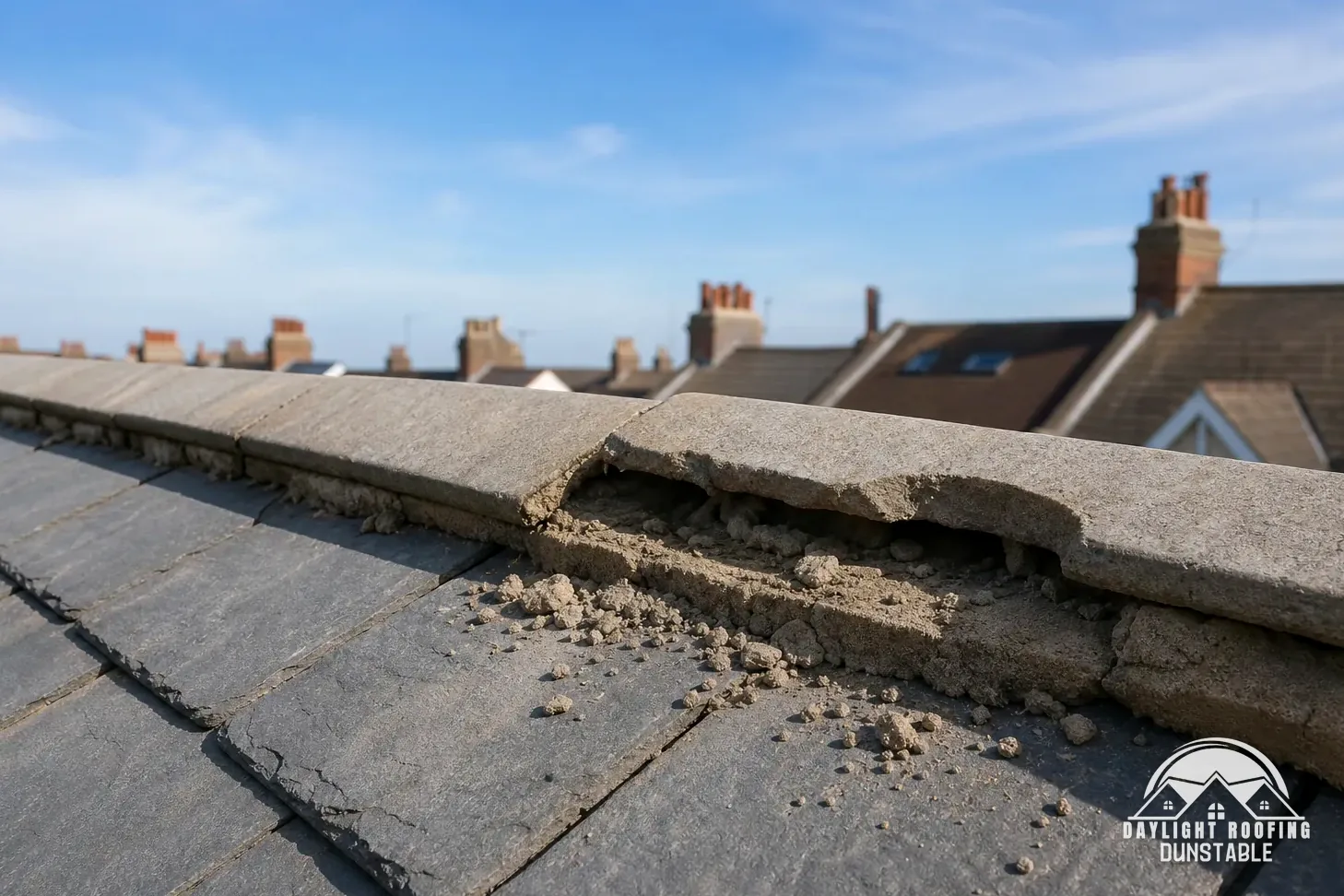
A verge in trouble can show as cracked pointing, a dark gap beside the gable, or a tile standing higher than the rest. The roof verge answer describes each part of the edge in more detail, and the dry verge systems guide goes through the fittings.
Where each one wins and where it loses
Set side by side, the two differ on points a homeowner can see and points a surveyor looks at. The comparison below is general, and each point depends on the product chosen and on the state of the roof underneath.
| Point | Dry verge | Mortar verge |
|---|---|---|
| How the edge is held | Mechanical fixings | Mortar bed |
| Look from the ground | Made trim, even line | Pointed joint, hand finish |
| Ageing | Fittings can be checked | Pointing can crack and drop |
| Repair | Replace a unit or fitting | Re-point or re-bed |
Appearance is the point where a dry verge can look different, since the trim is a manufactured profile. On a period house or a street with a strong character, that can matter to the owner. In a conservation area, or on a listed home, check with the council before choosing, because the look of a gable edge may be part of what the council weighs up.
Upkeep differs too. Mortar can crack with frost and movement, and the loose pieces can wash into the gutter below. A dry verge has no mortar to lose, though its fittings are still part of the roof and are worth a look whenever the roof is inspected. Neither type removes the need to look up now and then.
What the standards say about mortar at the edge
BS 5534 covers how tiles and slates are fixed on pitched roofs, and its 2014+A2:2018 edition is current. Marley points out that installing to BS 5534 "isn't required by law". It also notes that the 2015 amendments made it clear that mortar "could no longer be relied upon as the only means of securing the roof covering". BS 8612:2018, also current, specifies the dry-fix kits that take the place of mortar along a verge.
None of this turns every mortar verge into a fault. A bedded verge can still be repaired or re-bedded, and mortar can sit alongside a mechanical fixing. What the standards point towards is a verge that does not depend on the bed alone, and the mortar verge repairs guide covers what a repair involves.
On price, MyJobQuote, on a page updated 8 October 2026, says a dry verge system "usually falls between £500 and £2,000". The range comes from a third party, not from us. Gable length and access change the figure, and so does the condition of the old edge. The quote from Daylight Roofing is a single written total that follows the survey.
For the wider picture of ridges, hips and verges, start from the ridge and verge repairs hub. Sending a photo of the gable by WhatsApp to 07880 284133 is a fair first step.