
The short answer
A ridge tile is a shaped tile, curved or angled, that caps the join where two roof slopes meet at the top. It covers the gap between the last courses of tiles on each side and keeps rain and wind out. It is held either on a bed of mortar or with mechanical fixings.
What a ridge tile does
Where the two slopes of a pitched roof meet, the last course of tiles on each side stops short of the very top. That leaves a gap along the apex, and ridge tiles are laid over it. Each one is a hollow, arched or angled tile that spans the gap and overlaps the slopes on both sides, shedding rain to either side and closing the opening against wind.
A ridge is a series of these tiles laid end to end, with a joint between each pair. Along the run, the tiles rest on a bed of mortar in the traditional method, or on a batten and fixings in a dry-fixed system. A closing piece finishes each end of the line, which the ridge end cap answer describes.
The ridge tile belongs to the covering, and that makes it a different thing from the ridge itself. The ridge is the timber line at the apex where the rafters meet, while the ridge tile is the tile that caps it. On a slate roof the capping can be different again, and the slate ridge answer deals with that case.
Because it sits on the highest line of the roof, a ridge tile has to resist the wind lifting it as well as the rain running over it. The holding it needs is worked out for each site, so one tile can need different fixing on different roofs.
Profiles and materials
Manufacturers make ridge tiles in clay and in concrete, in several shapes. Each maker lists its own range under its own names, so half round, angled and matched profiles are read as general families rather than any one product.
| Profile | Shape |
|---|---|
| Half round | A semicircular arch |
| Angled | A sharp inverted V |
| Matched to the tile | Made to suit the roof tile profile |
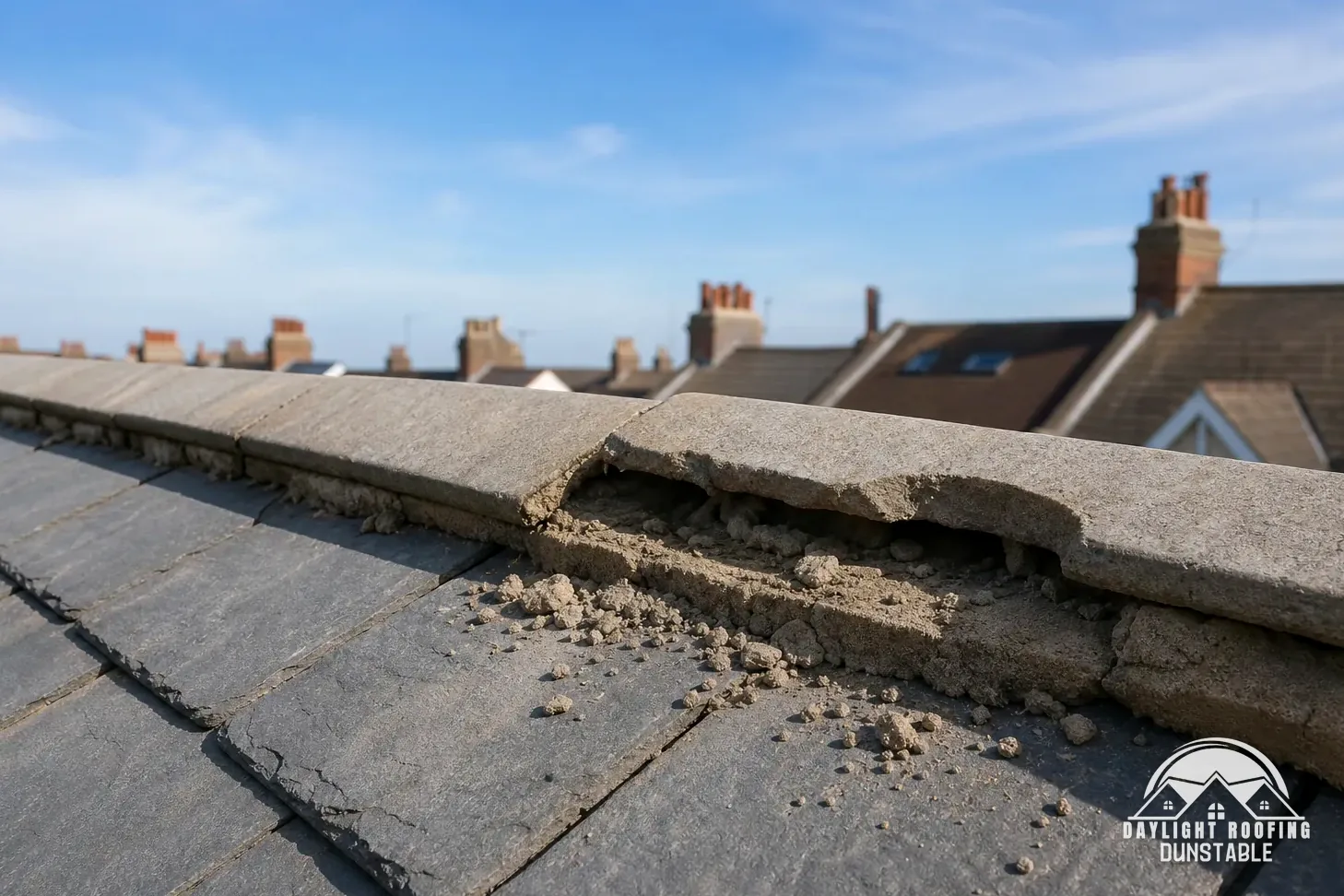
The right profile for a roof is the one that suits the covering already on it. A ridge tile in the wrong shape can leave gaps along the joint, and a colour that does not match can stand out against the slopes. For a roof being repaired, the survey identifies what is there, and a photograph of the existing ridge taken from the ground is a fair start. Clay and concrete tiles also differ in surface finish and in how they age, so the colour of an older ridge can have shifted since it was laid.
The types of ridge tile guide goes through the range. Which profile and material a particular roof carries is read on the roof itself, from the tiles already in place along its ridge line.
How a ridge tile is held in place
On a bedded ridge, each tile sits in mortar laid along the apex, and the joints are pointed. That was the traditional method. Marley says that installing to BS 5534 "isn't required by law", yet since the 2015 amendments, mortar "could no longer be relied upon as the only means of securing the roof covering".
For the tiles along the top and down the hips, Marley's guidance is that they should be "mechanically fixed to resist the calculated wind uplift force". A mechanical fixing is a clip, screw or strap that anchors the tile to a batten or the roof structure. A site-specific fixing specification under BS 5534 allows for how exposed the roof is, so each roof has its own figure.
BS 5534:2014+A2:2018 is the current edition of the code of practice for slating and tiling, and BS 8612:2018 is current for dry-fix kits. A dry-fixed ridge uses a batten, clips and made fittings in place of mortar. The re-bedding versus dry ridge guide compares the two routes for when a ridge has to be redone.
A ridge tile that has slipped, cracked or dropped is a sign that something has changed beneath it. The ridge and verge repairs hub sets out what repair involves. A photo from the ground, sent by WhatsApp to 07880 284133, can show whether one tile or the whole run is affected, though the survey on the roof is what settles it. The written quote that comes afterwards gives a single total for the work.