
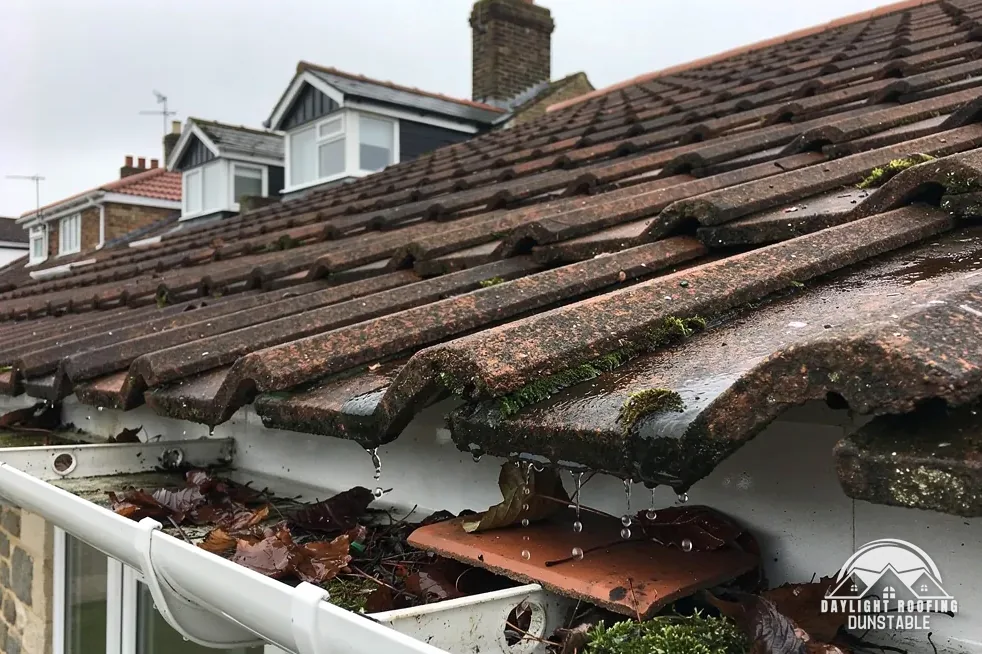
What listed and period change before cleaning starts
A listed building is one that has been entered on the national list for its special architectural or historic interest, with the roof counted in the protected fabric. A period home is an older house that may not be listed at all. The two overlap, since plenty of listed houses are period homes, but a period home with no listing is treated under the ordinary rules, subject to its conservation area and any Article 4 direction that applies.
The roof matters more on an older house than a newer one. Hand-made clay tiles, stone slates, Welsh and other natural slates and old bedding all carry the age of the building in them. A cleaning method that takes a little off a modern concrete tile can take far more off a soft old clay one, and a tile that has gone cannot be matched from a catalogue.
That is why the order of questions changes. On a modern roof the question is what method is quickest. On an older roof it is whether the work will affect the character of the building, whether the council needs to be asked first, and which method does the least to the surface. The answers come before anyone sets foot on the roof.
Cleaning a listed building roof also raises a point of language. A clean and a repair are different things in everyday speech, but consent rules look at what the work does to the building as a whole, not at what the job is called. This is the reason to put the question to the council rather than guess.
Listed building consent and permitted development
Works that affect a listed building's character need listed building consent. The Planning (Listed Buildings and Conservation Areas) Act 1990 section 7 puts it in terms of works carried out "in any manner which would affect its character as a building of special architectural or historic interest". It is a separate system from planning permission, and the council that decides it is the local planning authority.
Listing does not take away a house's permitted development rights for roof work. The GOV.UK technical guidance on permitted development says Class C covers other alterations to roofs, such as re-roofing, and re-roofing a house is normally permitted development. Listed homes keep their permitted development rights for roof work. Listed building consent is a second layer, needed for anything that touches the building's character, so the two have to be read together.
Whether a particular clean affects character is not something this page can settle. A light brush-down of growth may leave the building as it was, while stripping the surface of old tiles or changing their colour may not. The council holds the answer for a given building, and an email before work is cheaper than a notice afterwards.
- Ask the council in writing before any treatment that changes how the roof looks
- Keep the reply with the quote and the listing details
- Ask again if the method changes between the quote and the day
- Check any conditions that came with an earlier consent
Conservation areas and Article 4 directions
A house does not have to be listed to sit under extra controls. A conservation area is a place whose character the council has chosen to protect, and permitted development rights are stricter there. Central Bedfordshire Council, the council for Dunstable, points residents to its map and says conservation areas can be found by entering a postcode on My Central Bedfordshire. Other councils keep lists or maps of their own.
Dormers and other roof enlargements need planning permission in a conservation area, which is a different matter from cleaning. The cleaning question is whether an Article 4 direction applies. An Article 4 direction can remove further permitted development rights, so check with the council first.
What a direction covers differs from one council to the next. North Herts Council's Hitchin direction covers roof alterations and chimneys with other matters, while Central Bedfordshire Council's Toddington direction names extensions, porches and outbuildings and has no roof item. Nothing carries over from one place to another, and the only reliable source is the council's own list for the street in question.
A direction on a house is a reason to read the wording rather than assume. Repairs to match existing materials are treated differently from changes in some places, and Milton Keynes says so for Wolverton and Olney. Whether the same applies near you is for your own council to confirm, and the conservation officer or planning team can be asked by email.
Old clay tiles and slates: why gentle matters
Hand-made clay tiles are softer and less even than modern ones. They can be thinner at the edge, uneven on the face and open to water at the surface, so they take cleaning less well than a modern tile does. Marley, a tile maker, says: "The use of high powered jet washes is not recommended as it can damage the surface of the slate or tile, thus reducing its expected life considerably". The warning names slate and tile of any kind.
HomeBuilding gives an approximate lifespan of 60-80 years for clay tiles, and for reclaimed Welsh slate 50-80 years. Both are general figures for new or reclaimed material, and a roof that has already stood for generations is outside what any table covers. Tile wear is also what the roofer reads on an old roof, because the condition of the surface says what the roof can take.
Natural slate has its own cleaning rules, covered in how to clean a slate roof. Slates on old roofs may be held with nails that have rusted and with hooks that have loosened, so a pull or a push from a brush can lift one. A slate that comes away is a repair, and the old one is worth keeping for matching.
Chilterns buildings carry a further historical note. The Chilterns Conservation Board's 2007 roofing note describes plain clay tiles as "universally predominant" across the Chilterns' traditional buildings, a design observation for the Chilterns only. It says nothing about roofs elsewhere in Bedfordshire, Hertfordshire or Buckinghamshire.
Gentle methods, in order of preference
The table sets out the main choices from the gentlest to the most severe. It is a general description, and the condition of the roof can move any row up or down.
| Method | Risk to old fabric |
|---|---|
| Hand lifting of moss | Low, if done with care |
| Soft brush | Low on sound tiles |
| Low-pressure rinse | Moderate on soft tiles |
| Biocide treatment | Depends on product and fabric |
| High-pressure jet | High: surface loss |
A trial patch is a reasonable step on an old roof. A small area out of sight of the street can be cleaned first and looked at before the rest is done, and the result tells everyone what the surface will stand. It costs little and it can save a whole slope.
Patience helps too. Old roofs carry a patina of age, and a degree of lichen on a historic tile is part of how it looks. Removing every trace can leave a tile looking new in a way that sits oddly on a period house. The point of cleaning is to stop growth that is holding water against the tile, not to return the roof to the day it was laid. How each growth behaves is set out in the guide to moss, lichen and algae.
Chemicals, lime mortar and what sits below
Older roofs can be bedded in lime mortar, which is softer than modern cement mortar and weathers differently. A brush or a jet that would not trouble a cement bedding can take lime out of a ridge or a verge. A roof that has already lost some of its pointing is more at risk, and a loose ridge tile is a repair to look at before the brush goes anywhere near it.
Biocide treatments raise a separate set of questions on a period house. Run-off goes down old stone and brick walls, over timber windows and sills, and across lead sheets and old cast-iron gutters. The product label states what the product may harm, and an older house has more kinds of surface in the path of the water than a new one. Where a roof has a lead valley or flashing, lead is a metal that some products can mark.
Hedges, climbers, old trees and a garden pond are all in reach of the run-off from a period house, and a water butt connected to an old downpipe may collect it. The sensible order is to ask for the product name, read the label and decide what to protect before the day. A separate guide, roof coatings, covers surface coatings, and a coating on a listed building raises its own consent question.
Old roofs are also home to wildlife. GOV.UK says "All bat species, their breeding sites and resting places are fully protected by law", and a period roof with gaps under the tiles can hold a roost. Work that affects a roost can need a Natural England licence, and the page on roof work and bats in the roof sets out the position.
Access, scaffold and the written price
Period houses can be awkward to reach. Steep pitches, tall chimneys, low eaves over a narrow pavement and old gutters that were not built to take a ladder all make access a larger part of the job. Gutters that look sound can pull away under the load of a ladder, and a ladder on a listed building should rest on a plank or a stand rather than on the old fabric.
Scaffold set up in the road or on the footway needs the highway authority's licence; we arrange the licence with our scaffolder. In Dunstable that authority is Central Bedfordshire Council, while other councils run their own rules. Scaffold is part of the written quote, which comes as one total price after a survey.
A house with an outbuilding or a garage roof carries a separate check. HSE's advice is: "If the building was built or refurbished before 2000, assume that there is asbestos in it." HSE adds that "AC roofs are always fragile", so a sheet roof on an old shed or garage is not somewhere to walk or lean a ladder.
A photo sent on WhatsApp gets a look first, whether it shows the roof from the ground or the conservation area map for the street, and the map saves time when the council is asked. One written total follows the survey, and the wider cleaning work is gathered under roof cleaning.