
The short answer
It depends what your own policy says, and moss damage sits awkwardly with cover aimed at one-off events. Moss builds slowly, and gradual wear or lack of maintenance is the kind of thing a policy can exclude. Read the document, photograph any damage before anything is moved, and ask your insurer directly.
Why gradual damage is treated differently
Home insurance policies are written around events. A storm lifts tiles, a tree falls on a roof, a pipe bursts. Moss is none of those things. It grows over seasons, keeps damp pressed on the covering, and wears at it slowly, so there is no single moment to point to. A policy can word its cover and its exclusions in a way that puts gradual deterioration and routine maintenance outside what it pays for.
This describes how policies can be drafted, and the actual terms differ from one insurer to the next. The only way to know where yours stands is to read the full policy document and its schedule, looking at buildings cover, the list of insured events and the exclusions. A short summary sheet is not the same as the full terms.
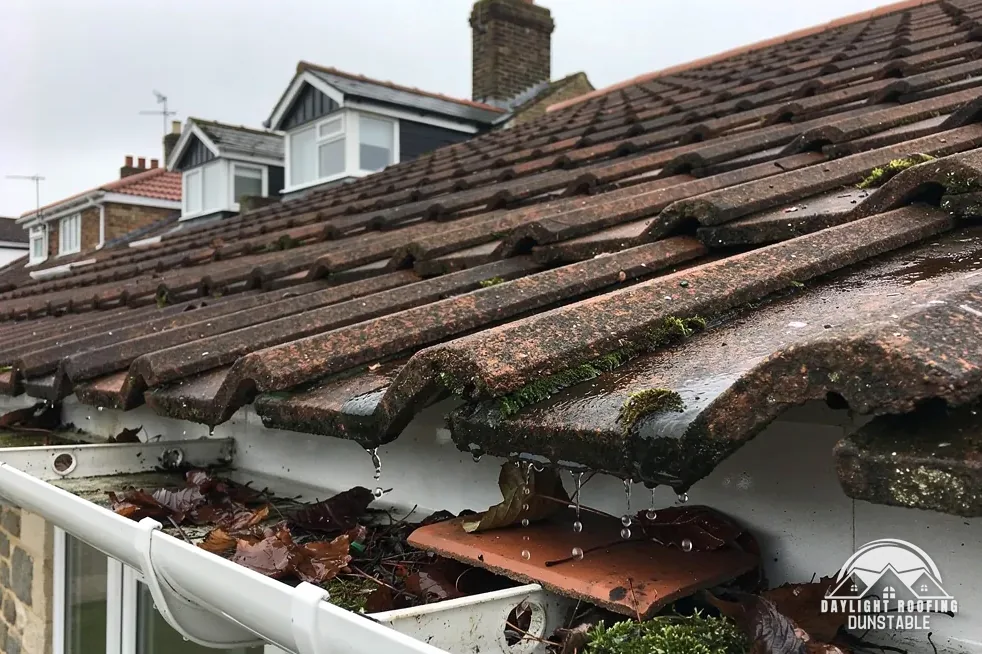
Damage that moss has contributed to can be harder to classify than damage with one clear cause. A tile that cracked in a gale on a roof covered in moss may be argued over differently from a tile that cracked in the same gale on a clean roof. The guide to whether moss damages concrete roof tiles looks at what moss can do to a covering.
What the Financial Ombudsman says about storms and evidence
The Financial Ombudsman Service sets out how it weighs storm claims, and its wording is a useful guide. It says "a storm usually involves violent winds, usually with rain, hail or snow". It adds: "Rain, hail or snowfall by itself can constitute a storm." On evidence, it says it will "usually look at expert reports and photos", and that where a policy exclusion is relied on, the burden sits with the insurer, who might prove it with an inspection report. Those lines are about storms, and the same attention to evidence is sensible for any roof claim, whatever the suspected cause. A claim for moss damage is more likely to turn on what the policy says about wear, deterioration and upkeep than on the weather.
| Point | Ombudsman wording |
|---|---|
| What a storm is | "a storm usually involves violent winds, usually with rain, hail or snow" |
| Rain alone | "Rain, hail or snowfall by itself can constitute a storm" |
| Evidence | It will "usually look at expert reports and photos" |
| Exclusions | The insurer has to prove the exclusion applies |
None of this says moss damage is covered, and none of it says it is not. It describes how storm disputes are weighed once they reach the Ombudsman. What it does show is where the weight sits: photographs taken before anything is moved, and a written report on the cause, are the kind of material the Ombudsman says it will usually look at.
What to do before you claim
Photograph the damage as it is found, before a tile is lifted, a gutter emptied or a stain cleaned away. Take wide shots and close ones, and note the date. Then tell your insurer, and ask which section of the policy they are treating the damage under. Keep their replies in writing. If urgent work is needed to keep water out, take photographs first and keep any material that comes off.
If a claim is turned down, ask for the reason in writing. The Ombudsman's published timings are these: "For most complaints, a business has up to 8 weeks to consider a complaint", and after a final response you have 6 months from the date on it to approach the Ombudsman, whose number is 0800 023 4567. The 6 months count only from the final response.
A roof survey shows what is up there and its condition, and a photo on WhatsApp, 07880 284133, will be looked at. Whether a claim is accepted is for the insurer and your policy to settle. The guide to moss and roof leaks and the roof cleaning hub give background on the roof side.