
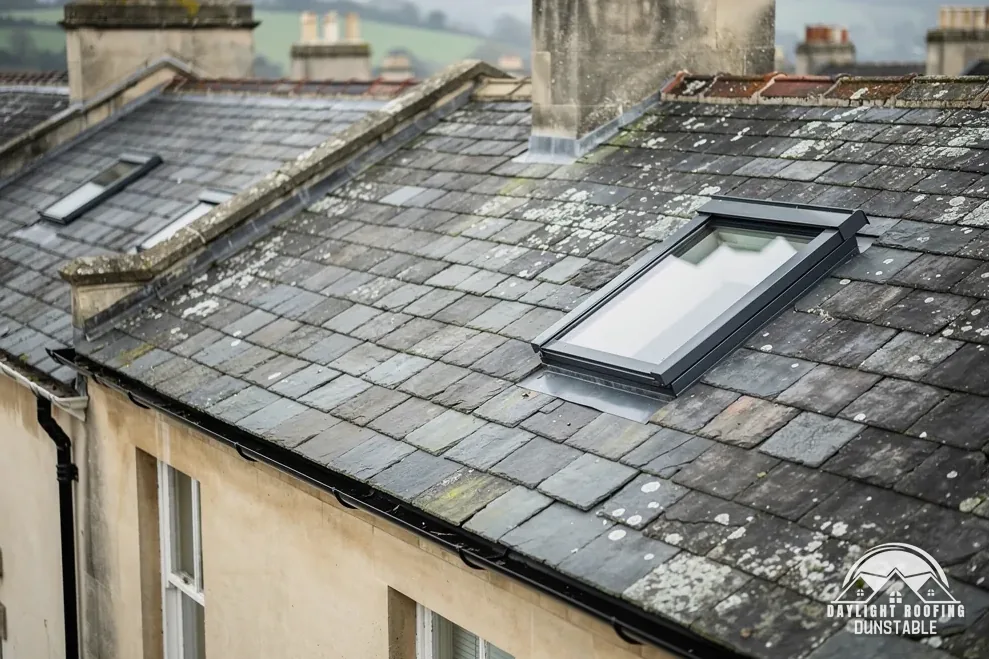
The short answer
Yes, sound old slates can be reused. They are lifted and sorted, re-holed where the old nail holes have worn or split, and fixed again on new battens and underlay. Cracked, laminated or flaking slates are set aside, and a survey of the roof decides how many can go back.
How old slates are sorted for reuse
Reusing slates starts when the old covering comes off, because each slate is handled and judged as it is lifted. A slate that is whole, flat and sound is a candidate for the roof again. A slate that has cracked across, split along its layers or begun to flake is not, and it is set aside however good the rest of the stack looks.
A slate can be tapped and listened to. A clear note suggests a sound slate, while a dull or buzzing sound may point to a hidden crack, though the sound is a guide and not a test. The edges and the surface are looked at too, because slate that is breaking up in layers has little life left in it. Each slate is turned over and looked at on both faces and along its edges before it is passed as sound.
The reusable slates are then graded by size. A roof is laid so that courses of one size sit together, so slates are sorted into lengths before they go back. Any shortfall is made up with slates of the same size and thickness, and the guide on mixing old and new slates explains how that match is made.
Nail holes, fixings and the roof beneath
A slate hangs from its fixing, so the hole it hangs from is the weak point. Over many years a nail can rust, or the slate around the hole can wear and crack. A slate whose hole is sound can be hung again from it. A slate whose hole has worn can be re-holed, with a new hole made in a sound part of the slate, and the old fixing line then lies beneath the overlap above.
| Condition | Outcome |
|---|---|
| Whole, flat, sound hole | Fixed again as it is |
| Whole but worn hole | Re-holed, then fixed again |
| Cracked, split or flaking | Set aside |
Reusing the slates does not mean reusing everything under them. Battens that have rotted or split are replaced, and fixings are chosen to suit the pitch: hook fixings are ruled out below 25 degrees, according to Cupa. The slates may be sound while the nails that held them have failed, which is the pattern described in the nail fatigue guide. Where the existing underlay has perished, it is renewed at the same time, since the covering is already off and the old underlay is in plain view.
How long reused slate lasts and who decides
A reused slate has already weathered, so its remaining life is shorter than that of a new one. HomeBuilding (last updated 30 September 2025) gives approximate lifespans of 100+ years for Welsh slate, 75-100 years for Spanish natural slate and 50-80 years for reclaimed Welsh slate. All three are approximate ranges for the stone, not readings of any one roof. None is a promise about a particular roof, and a reclaimed slate has already spent part of its life elsewhere.
Whether to reuse at all is a question for the survey. If the slates are in sound condition and the roof is being renewed for another reason, such as failed battens or a tired underlay, reusing them can keep the look of the roof. If many have cracked, new slate may be the better course. The repair or replace a slate roof guide covers that choice.
A survey takes in the slates, the nails or hooks, and the timbers underneath. What we then give you in writing is one figure for the roof as found. Send a photograph to 07880 284133 on WhatsApp if you would like a first view. More on the work is on the slate roofing page.