
The short answer
Slates slip because whatever holds them has failed. A corroded or worn nail can lose its grip, a softened batten can stop holding the nail, and a slate weakened by frost or a knock can break around its nail hole. One slipped slate can be a repair, but several suggest the fixings are failing.
The fixings behind a slipped slate
Slates hang rather than rest. Each is held by a nail through a hole near its head, driven into a batten, with the row above lapping over the nail. When a slate slides down or drops out, the cause lies somewhere in that small chain: the nail, the hole in the slate, or the batten that takes the nail.
A nail can corrode until it thins and snaps, or until it no longer grips, which is the condition described in nail fatigue on a slate roof. The nail hole can also wear wider as the slate shifts in wind, letting the head pull through the stone. In either case the slate is no longer pinned, and gravity then draws it down the slope until its foot dips below the line of the others.
One slate that has slipped beside a well-fixed neighbour can point to a single weak nail. Slates slipping in a cluster, or across a whole slope, point to fixings of the same age failing together, and the roof is then reaching a stage where individual repairs may not hold for long.
Battens, frost and knocks as causes
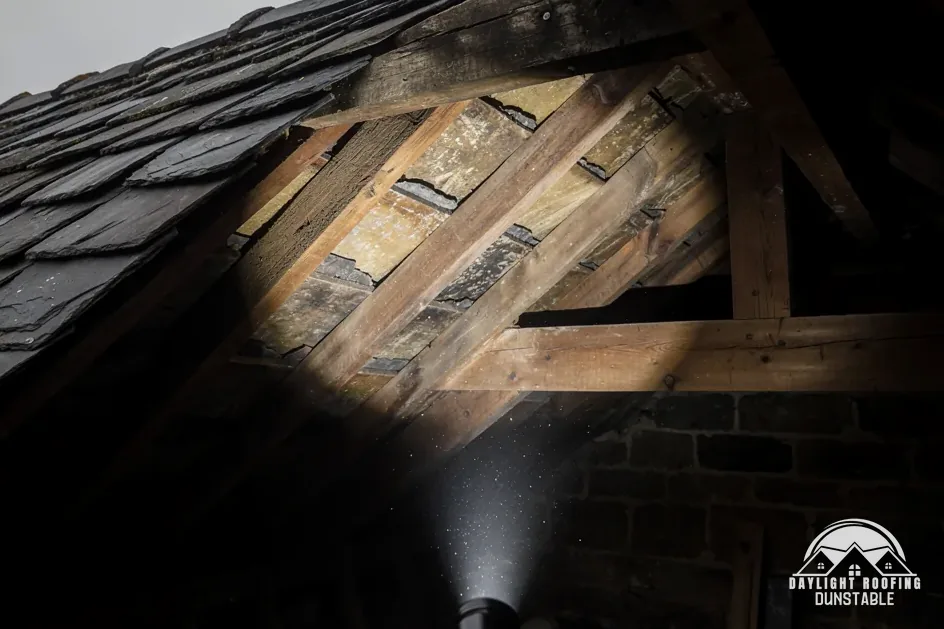
Under the slates sit timber battens, and a slate is only as secure as the timber its nail is driven into. A batten that has softened, split or rotted, perhaps from water that has been seeping in for years, can hold a nail loosely or not at all. A slate fixed to such a batten can slip even though the nail itself is sound.
- Soft or rotten battens, which let nails pull out.
- Frost, which can crack a slate that has absorbed water, or break the edge around a nail hole.
- Impact from a falling branch, a ladder or a person on the roof, which can crack a slate at once or weaken it so that it fails later.
- Slates fixed too sparingly in the first place, with one nail where two were needed.
Frost is a slow cause, and its damage builds over more than one winter. A slate that is porous or already cracked can take in water, and when that water freezes it expands and can split the slate along its layers. That breaks the stone around the nail without any visible knock. Each of these causes can apply to a single roof at once, so the slates, the nails and the battens are read together and not one at a time.
What to do about a slipped slate
Start from the ground. Scan each row for a slate that has dipped below its neighbours, or for a shadowed space where one has gone, and look in the gutter and on any lower roof for fragments. Inside, check the loft and the ceiling beneath that slope after rain for damp or daylight. A photograph of the slope and of any staining gives a roofer something to work from, and jotting down when you spotted it, with the weather, helps to place the cause.
Leave the slate where it is and stay off the slope. Wet slate is slippery, slates crack underfoot, and one without a fixing can shift further under a boot. The page on what a tingle is describes the small hidden fixing used to hold a single replacement slate in place, which is a fair repair for an isolated loss.
If the survey shows the nails or battens failing across a slope, relaying that slope can be the sounder course, and repair or replace a slate roof sets out how to weigh the two. The wider slate roofing page gives the full picture. You then get one price in writing, naming the work proposed.