
Call 01582 935272

Maids Moreton · 27 road miles north-west

Roofers in Maids Moreton

Loft damp, porch and lean-to roofs, tile repairs and re-roofs for Maids Moreton houses, in a village with a Grade I church and a conservation area, each priced as a single written total.

Get a written quote

Call 01582 935272WhatsApp us

Council
Buckinghamshire
Road miles
27
Conservation area
Maids Moreton
Building control
Buckinghamshire Council

Roofs beneath St Edmund's tower and the cottages

Maids Moreton is a Buckinghamshire village to the north-west of Dunstable, 26.7 road miles away and about 41 minutes by road. Maids Moreton parish had 864 usual residents at the 2021 Census. The Church of St Edmund is listed Grade I (entry 1215188, first listed 13 July 1966). Olde Page's Cottage (entry 1215342, first listed 20 August 1980) and Pightle Cottage (entry 1215340, first listed 22 August 1983) are Grade II, and so is Chestnut Cottage (entry 1231752). Those entries are the first thing read before any roof beside them is priced. On a listed cottage the roof falls within the listing, so the method of repair is judged as well as the material.

Buckinghamshire Council made the designation for the Maids Moreton conservation area, and it also takes the village's planning applications. A roof inside it, or next to a listed cottage, gets the council's view on the address first. After that comes the survey of the roof, and then one written total, with anything else the survey meets told to you in plain words.

  1. 01Church of St EdmundGrade I and Church of England: roof work belongs to the faculty process, which stands in for listed building consent.
  2. 02Olde Page's CottageListed Grade II in 1980 (entry 1215342), so a new covering raises the consent question ahead of any price.
  3. 03Pightle CottageListed Grade II in 1983 (entry 1215340), so repair methods and any new material are put to the council early.
  4. 04Chestnut CottageListed Grade II (entry 1231752), so scaffolding and a change of tile wait for the council's answer on character.
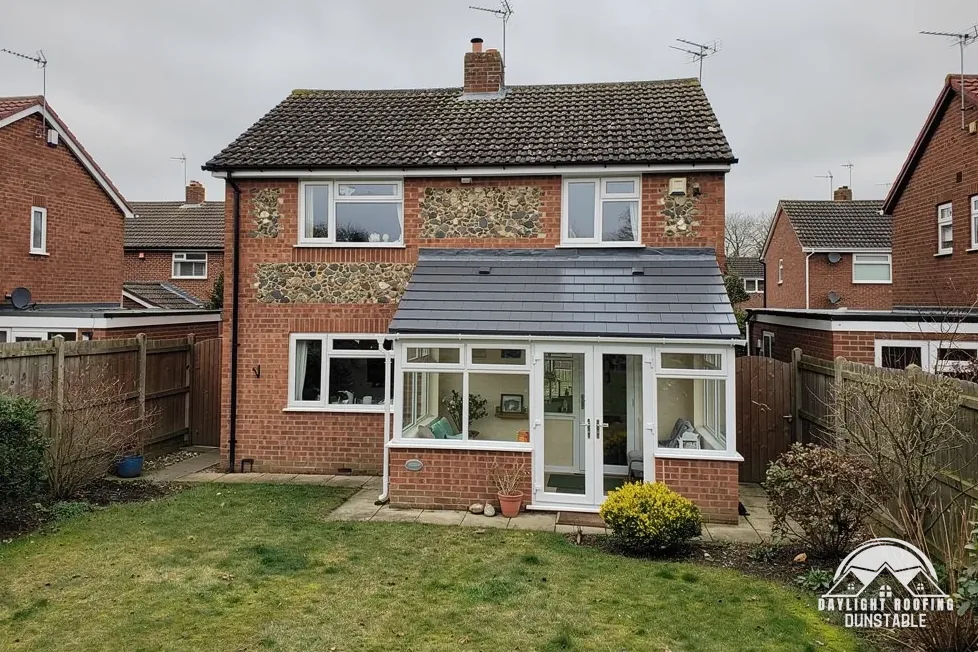
A brick house with a tiled roof and a conservatory at the back

The roof, in plain words

Condensation
Moisture from indoor air settling as water on cold surfaces.
Lean-to
A single-slope roof propped against the side wall of a building.
Pantile
A clay tile curved in an S shape and laid in interlocking rows.
Parish
The local area whose census count the village figure belongs to.

The plain-as-day roof check

Four Maids Moreton roof problems, taken from the inside out

4 checks about 3 minutes to read

  1. Damp in the loft
  2. Porches and lean-tos at a low pitch
  3. A few tiles, counted and priced
  4. Sheet roofs on sheds and garages

01 Damp in the loft

Damp in a loft has two explanations that need different cures: water coming through the covering, or moisture from the house that cannot get out. The marks differ. A leak leaves a stain that appears after rain and tracks to one spot below a tile or flashing. Condensation shows as dark spotting over wide stretches of the rafters, with wet insulation and a stale odour, and it does not wait for rain. Telling the two apart before any repair is ordered keeps the money on the right fix.

Marley's ventilation figures for a loft that is cold, under a high-resistance underlay, are "25mm along the length of the eaves for pitches of 15° or less" and "10mm along the length of the eaves for pitches of more than 15°". BS 5250:2021 is the current standard on managing moisture in buildings. A torch beam run along the eaves reveals whether insulation has been packed into the gap that those figures need open. Where insulation has been added over the years, the eaves gap is the first thing to check.

02 Porches and lean-tos at a low pitch

A small roof on a shallow pitch narrows the choice of covering, because each product has its own lowest slope. Marley lists 15 degrees for its Lincoln clay pantile, 15 for its Mendip and Wessex concrete tiles, 12.5 for its Mendip 12.5 tile and 17.5 for its Edgemere and Modern-Duo. Those are product names, not places, and a clay Hawkins tile needs 30 degrees. A tile that suits the main slope may not suit a porch. A lean-to against a taller wall also needs a flashing where it meets that wall, and the pitch is measured with the flashing in mind.

Below a certain pitch the answer is a flat roof covering, not tiles. BS 6229:2025 covers flat roofs with continuously supported flexible waterproof coverings, and NFRC says it sets "a minimum 1:80 finished fall for general roof areas and internal gutters". When a small roof is being priced, its pitch is measured, since a guess from the ground can send the wrong product to site. See flat roofing.

03 A few tiles, counted and priced

Which? Trusted Traders put £75 to £400 on swapping out up to six ordinary tiles that have broken or gone (November 2025, excluding VAT). On the MyJobQuote page dated 6 October 2026, replacing roof tiles averages "around £215"; the average roof repair for 2026 is around £650. Those pages describe different jobs, and a real figure depends on access, the tile and the extent of damage at the house in question.

A slipped tile may have neighbours in the same condition. Nails corrode, battens soften and a neighbour tile cracks, so the survey looks at the course and the batten beneath, not only the gap. From the lane, a gap in the pattern, a tile hanging at an angle or a shard in the gutter points to where to start. More is under roof repairs. A tile fixed with a fresh nail onto a soft batten will not stay, which is why the timber is probed.

04 Sheet roofs on sheds and garages

A corrugated sheet roof on an outbuilding may be asbestos cement. HSE's advice is "If the building was built or refurbished before 2000, assume that there is asbestos in it." HSE also says "AC roofs are always fragile", so nobody should walk on one to inspect it. Sheeting that is carefully removed whole is non-licensed work; "asbestos insulating board", which HSE lists in soffits, is mostly licensed.

Waste from the work goes in a lockable skip, because HSE says "it is not good enough to throw sheeting over a standard skip". On MyJobQuote's pages, removing asbestos from a roof averages around £2,750 and replacing a garage roof between £750 and £3,500. A survey identifies the material first, and nothing is drilled, cut or broken until it has been. If the sheets turn out to be asbestos cement, the job is planned around that finding before any quote is settled.

The dashed ring takes in the nearest towns and villages we cover around Maids Moreton. Map tiles © Esri; map data © OpenStreetMap contributors.

Maids Moreton roof questions, one answer apiece

01How can a Maids Moreton owner tell condensation from a leak in the loft?

Look at when and where the marks appear. A stain that shows after rain and sits under one tile, flashing or pipe points to a leak. Dark spotting across a wide area of the rafters, wet insulation, or a musty smell that persists regardless of rain points to condensation. Photograph each sign with its position noted, and a WhatsApp picture can be reviewed ahead of a visit being fixed. The survey then checks the covering and the ventilation together, since the two can coexist and each needs its own remedy. Checking the loft on a dry morning and again after rain shows which kind of mark is changing.

02What approval does a roof repair at St Edmund's Church need?

St Edmund's belongs to the Church of England and is listed Grade I (entry 1215188). Its roof is therefore dealt with through the church's faculty process, which stands in for listed building consent. Replacing roof lead in kind appears in List B of the Faculty Jurisdiction Rules 2015, where all that is asked is the archdeacon's written notice. The exemption displaces listed building consent alone, and exterior work may still meet a planning question of its own, depending on the job. Cottage owners are outside the church's process altogether, and a cottage roof is a matter for the council.

03How does listing affect roof work at Olde Page's Cottage or Pightle Cottage?

Listing leaves the house's permitted development rights where they are, yet work done "in any manner which would affect its character as a building of special architectural or historic interest" needs listed building consent. Olde Page's Cottage (entry 1215342), Pightle Cottage (entry 1215340) and Chestnut Cottage (entry 1231752) are each Grade II. Whether re-covering in matching tiles counts as affecting character is Buckinghamshire Council's to decide, so the enquiry precedes the ordering of tiles and the stripping of the old covering. The method of repair is raised in that same enquiry.

04Does the Maids Moreton conservation area slow a roof job?

It adds a check ahead of the work. Buckinghamshire Council designated the Maids Moreton conservation area, and the council's response on the address is gathered ahead of choosing a covering. An Article 4 direction can remove further permitted development rights, so we check with the council first. Roofs and planning in general are covered in the planning guide, while the council's reply for the address comes first. Where the answer is clear, the job proceeds exactly as it would elsewhere, with the same survey and the same single price. The enquiry names the address and the intended covering.

05Who applies for scaffolding on a Maids Moreton road, and at what cost?

Buckinghamshire Council sets the fee at £402.78 for 28 days, £69.09 to renew and £777.63 for a retrospective licence. Council wording for applicants, from Buckinghamshire Council: "You must be a registered scaffolding company to apply for a licence." We arrange it with our scaffolder, so the household makes no application. A scaffold, if the work calls for one, is part of the written quote. Should the job overrun, a renewal prolongs the licence and the frame stays put. Nothing needs signing on the household's side beyond the written quote.

06How long do slate and clay roofs last on published figures?

HomeBuilding (last updated 30 September 2025) gives approximate lifespans of 100+ years for Welsh slate, 75-100 for Spanish natural slate, 50-80 for reclaimed Welsh slate, and 60-80 for clay tiles. Marley cites the BRE, which "determined a minimum life expectancy of 60 years" for clay. These describe materials in general, and a given roof's life depends on fixings, underlay and how it has been looked after. The survey examines the actual roof, and a published range is only a loose pointer to what to expect. Whatever the covering, the underlay and fixings beneath it age at their own pace.

07How long does a Maids Moreton owner have to take an insurer to the Ombudsman?

"For most complaints, a business has up to 8 weeks to consider a complaint", according to the Financial Ombudsman Service, and "You have 6 months from the date on the final response" to bring it to the Ombudsman. The two periods are separate, so the 6 months do not start when the 8 weeks end. The Ombudsman will "usually look at expert reports and photos", which is why dated pictures and any expert report help a storm claim; a broken tile is worth holding on to for the insurer.

08Must a neighbour be told before a Maids Moreton chimney breast comes out?

It is the building owner who must serve notice, and only where the breast is part of a party wall. For work to a party structure the Act's wording is "be served at least two months before the date on which the proposed work will begin". A neighbour who gives no reply within 14 days is "deemed to have dissented", and a surveyor is then appointed; dissent is no veto. Building Regulations approval "will always apply when removing chimney breasts as they are part of the building's structure", whether or not a neighbour is involved.

09Is there a way to check flood risk for a Maids Moreton house before drainage work?

GOV.UK offers a long-term flood risk check, whose results describe an area, with no promise about one particular home. For planning applications the Environment Agency has a separate flood map for planning, which gives flood information for a site. The results attach to an address, not to Maids Moreton as a place. For roof work the useful checks are practical: where the downpipes discharge, whether the gutters keep up, and whether the ground by the walls slopes away from the house. Standing water at the foot of a wall is a drainage problem to fix, and it should not be mistaken for a roof leak.

Get a written price for your roof

10-year workmanship guarantee, in writing

Tell us about your roof

Call WhatsApp Written quote