
Call 01582 935272

Buckingham · 26 road miles west

Roofers in Buckingham

Slate, tile and flat roof work for Buckingham homes, with a Grade I church and conservation areas in the picture, and one written total price after the roof has been surveyed.

Get a written quote

Call 01582 935272WhatsApp us

Council
Buckinghamshire
Road miles
26
Conservation area
Buckingham
Building control
Buckinghamshire Council

Roofs among Buckingham's Grade I landmarks

Buckingham is a town in Buckinghamshire, 25.7 road miles west of Dunstable and about 39 minutes by road. At the 2021 Census, Buckingham parish had 14,294 usual residents. Ordinary houses stand beside listed buildings of high grade here: the Church of St Peter and St Paul (entry 1282713) and Castle House (entry 1282698) are Grade I, and the Old Town Hall (entry 1282685) and the Old Latin School (entry 1201391) are Grade II*. The church, Castle House and the Old Town Hall were all first listed on 13 October 1952.

Buckingham has a conservation area, and the Stowe conservation area lies close to the town; Buckinghamshire Council designated both and is also the planning authority. St Rumbold's Well, a scheduled monument (entry 1017204), is near the town. Whether a given address is touched by any of this is something the council is asked before work is planned, since a restriction learnt late is harder to work round. The roof is surveyed first, and the one written total comes after that.

  1. 01Castle HouseListed Grade I (entry 1282698), so a roofline change is weighed against what makes the building special before any covering is ordered.
  2. 02Old Town HallListed Grade II* (entry 1282685) on 13 October 1952, so roof work is read against the list entry first.
  3. 03Old Latin SchoolGrade II* (entry 1201391), so work touching its character needs listed building consent, sought before a covering is ordered.
  4. 04Conservation area streetsHouses inside the Buckingham conservation area get the council's answer for their address before work is planned.
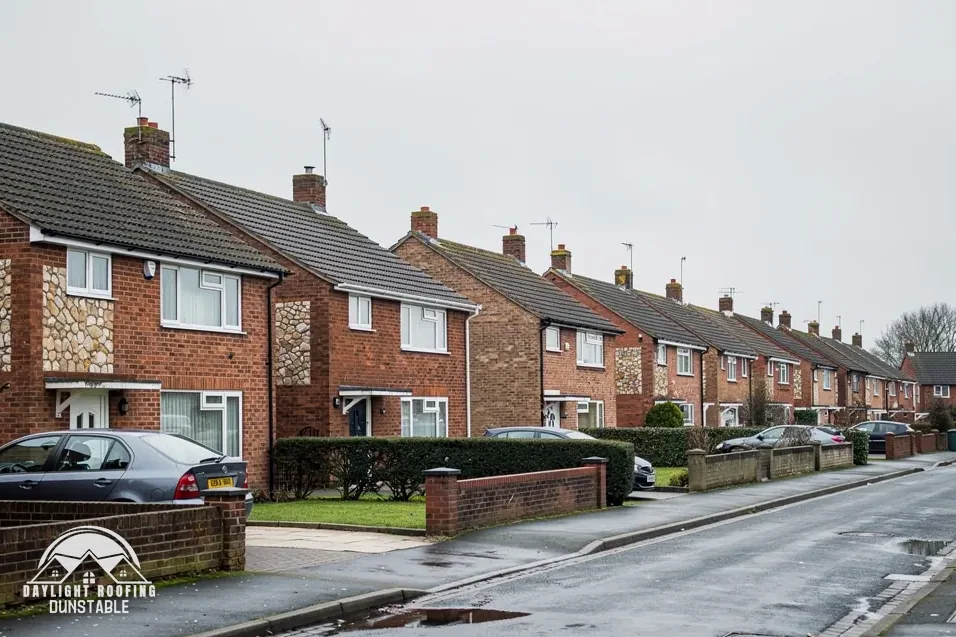
A street of brick semi-detached houses with tiled roofs

The roof, in plain words

Pitch
The angle of a roof slope, measured in degrees from the horizontal.
Headlap
How far each course of slates overlaps the course beneath it.
Fall
The slope given to a flat roof or gutter so water runs to an outlet.
Scheduled monument
A protected archaeological site, off limits to works that lack authorisation.

The plain-as-day roof check

What a Buckingham roof shows from the street

4 checks about 3 minutes to read

  1. Slate pitch and hook fixings
  2. Flat roofs on extensions and garages
  3. Verge and gable edge
  4. Fascia and soffit boards

01 Slate pitch and hook fixings

Slates hang in overlapping courses, and the pitch, the slate length and the overlap together decide whether water runs off or creeps upward. Cupa, a slate supplier, reports that BS 5534 "also indicates that the minimum roof pitch for natural slate is 20 degrees in the case of a project situated in an area with moderate exposure and with a slate 500mm long and a 115mm overlap". On fixings, Cupa adds a separate limit: "hook fixings should not be used on any pitch below 25º". A slate that has slid down its course and left a gap points to a failed fixing, not just a loose slate, and the gap lets water reach the battens beneath.

HomeBuilding (last updated 30 September 2025) gives approximate lifespans of 100+ years for Welsh slate, 75-100 years for Spanish natural slate and 50-80 years for reclaimed Welsh slate. Those are published approximations, not a promise about any one roof. For slate generally, MyJobQuote says the average cost of fitting a slate roof is "around £7,800" (page dated 6 October 2026). More is at slate roofing.

02 Flat roofs on extensions and garages

A flat roof is never truly flat, because it needs a fall to carry water away. BS 6229:2025 is the current code for flat roofs with continuously supported flexible waterproof coverings, and the NFRC reports that it sets "a minimum 1:80 finished fall for general roof areas and internal gutters". IKO writes that "To achieve a 1:80 fall, the code of practice says that the roof should be designed for a fall of 1:40". Water lingering a day after rain, or a stain on the ceiling below, shows the roof is not draining as it should. Ponding also loads the structure, so a flat roof that holds a puddle is worth a survey even before it leaks.

Published lifespans disagree. HomeBuilding gives EPDM as 25-30 years and GRP as 25-30 years, while Less says EPDM "typically lasts 30 to 50 years" and GRP "lasts 25 to 40 years with minimal maintenance". Felt is 10-15 years to HomeBuilding and, to Less, "10 to 20 years depending on quality and installation". On a single garage of 6m x 3m, Which? Trusted Traders give £1,400 to £3,500 for felt and £1,950 to £4,000 for rubber EPDM with new boards, excluding VAT (November 2025). The covering is set out under flat roofing.

03 Verge and gable edge

Where a pitched roof stops at a gable wall, the edge tiles overhang the brickwork and are sealed along it. Mortar bedding was the old way of doing this, and Marley notes that after the 2015 amendments mortar "could no longer be relied upon as the only means of securing the roof covering". A dry-fixed verge, covered by BS 8612:2018, clips or screws the edge to the roof instead. MyJobQuote says a dry verge system "usually falls between £500 and £2,000" (page dated 8 October 2026).

From the street, look at a gable for mortar that has dropped away, an edge tile standing up from the line, or green growth marking the wall under the edge. Each shows that the edge no longer sheds water cleanly. The survey also looks beneath the edge, because the tiles need something firm to sit on, and rot in the batten ends under a verge cannot be seen from the street.

04 Fascia and soffit boards

Two boards finish the eaves: the fascia faces outward and holds the gutter, while the soffit is the panel fitted beneath the overhang. A uPVC retailer says that, installed correctly, its fascia boards "can typically maintain reliable performance for between 20 and 40 years". On MyJobQuote's page dated 17 September 2026, capping both fascias and soffits averages "around £800". Soft timber, a split joint or a gutter pulling away from its board shows a fascia is ready for attention, and a board that has gone soft cannot hold a bracket however the gutter is refixed.

Soffits on older houses need care. HSE lists "AIB white soffit panels to underside of roof eaves" among asbestos insulating board locations, and licensing applies to most work on that board. A panel that might be AIB stays untouched until someone competent has identified it. Guttering and the boards behind it are covered under guttering, soffits and fascias.

The dashed ring takes in the nearest towns and villages we cover around Buckingham. Map tiles © Esri; map data © OpenStreetMap contributors.

Roof questions from Buckingham homes and listed buildings

01Which parts of a Buckingham roof are worth photographing before a survey?

Take the whole elevation from across the street first, then the ridge, the chimney, the gable edges and the gutter line, each in daylight. Add the inside of the loft with a torch, showing any dark patch or daylight gap. A photo sent on WhatsApp is looked at before anything is booked, and it gives the survey somewhere to start. The survey itself still covers the roof from close up, because a picture taken from the ground cannot show what sits behind a ridge tile or under a flashing, and an old roof can look sound from the pavement.

02What does a Grade I or Grade II* listing mean for roof work at Castle House or the Old Town Hall?

Listed building consent is needed for work done "in any manner which would affect its character as a building of special architectural or historic interest", though a listed home keeps its permitted development rights. Castle House (entry 1282698) is listed Grade I; the Old Town Hall (entry 1282685) and the Old Latin School (entry 1201391) are Grade II*. Repairing in matching materials and switching to a new one are separate questions, and Buckinghamshire Council can say which a job is. It is better asked before any covering is ordered.

03What changes for a roof in the Buckingham or Stowe conservation areas?

The council's answer for the address comes first. Buckinghamshire Council designated both areas, so before a covering is chosen it is asked what applies there. An Article 4 direction can remove further permitted development rights, so we check with the council first. The planning guide sets out the ordinary planning tests for roof work, and the council's reply for an address overrides any general rule. A roof in either area is surveyed in the usual way, with the extra check alongside.

04How is the roof of the Church of St Peter and St Paul approved?

The church is listed Grade I (entry 1282713, first listed 13 October 1952). The consent route for a church roof depends on the denomination that uses the building, so it is confirmed with the church and the council, not guessed from outside. Whether the outside work also raises a planning question depends on the job itself. For a householder the point is simply that a church roof can follow a system of its own, while an ordinary house roof is judged by the council against the ordinary tests.

05Does St Rumbold's Well matter to a roof near it?

Only if the property or its land falls within the protected site. St Rumbold's Well, near Buckingham, is a scheduled monument (entry 1017204). No works to a scheduled monument may go ahead unless authorised: applications go to Historic England, and consent comes from the Secretary of State. That is a separate system from planning and from listed building consent. For an ordinary house roof, the map on the monument's list entry shows the scheduled area, and it is worth checking before any scaffold goes up. If the address is inside it, the work is planned around that restriction from the start.

06How long does a Buckingham scaffold licence last, and what does it cost?

Buckinghamshire Council, the highway authority, charges £402.78 for a licence valid for 28 days, £69.09 to renew it and £777.63 for a retrospective one. Buckinghamshire Council's rule is "You must be a registered scaffolding company to apply for a licence." We arrange the licence with our scaffolder, and the scaffold itself forms part of the written quote. A job that overruns the 28 days is covered by a renewal, so the scaffold does not have to come down midway through the work.

07Does taking out a chimney breast in Buckingham mean notifying a neighbour?

It does when the breast is on a party wall. Building Regulations approval "will always apply when removing chimney breasts as they are part of the building's structure". Under the Party Wall etc. Act 1996, the notice for cutting away a chimney breast must "be served at least two months before the date on which the proposed work will begin", and it is the building owner who serves it. Silence is not consent: once 14 days pass with no reply, the neighbour counts as "deemed to have dissented". Party wall questions go to a party wall surveyor, not building control.

08What does a full slate re-roof cost in outline for a Buckingham house?

The firm figure comes as a single written total once the survey is complete. Outside context: MyJobQuote says the average cost of fitting a slate roof is around £7,800, and HomeBuilding says the cost of a Welsh slate roof on a three-bedroom semi "might reach £18,000" (last updated 30 September 2025). Which? Trusted Traders give £7,000 to £21,000 excluding VAT for an average three-bedroom house. Access, the slate chosen and the size of the roof move a real quote, so these ranges are a loose frame only. A slate roof on a listed or conservation-area building can also carry consent steps that a plain re-cover does not.

09Do bats or nesting birds in a Buckingham roof change the plan?

It changes the order of work. Under the Wildlife and Countryside Act 1981 it is an offence if any person intentionally "takes, damages or destroys the nest of any wild bird while that nest is in use or being built". Damaging or destroying a bat roost is an offence whatever the intent, and GOV.UK names "repairing or replacing a roof" as an activity that may call for a Natural England licence. If bats or an active nest turn up, that part of the roof is left alone while the matter is dealt with properly, and the written total is settled once it is clear what the work involves.

Get a written price for your roof

10-year workmanship guarantee, in writing

Tell us about your roof

Call WhatsApp Written quote